
Each month in this Frank C. Chen Foundation calendar with a Formosa Files Taiwan History Podcast theme begins with two Chinese characters expressing a virtue or guiding ideal, such as compassion or a pioneering spirit. The lettering comes from the calligraphy of Yu Yu-jen (于右任, 1879–1964). Our choice has a connection to a place in Taiwan’s history: his calligraphy also appears at the tomb of Kaohsiung businessman Chen Zhong-he (陳中和), which today is also home to the headquarters and studio used by the podcast. The monthly headings carry that connection through the calendar, bringing the work of a celebrated calligrapher from a historic monument onto the printed page.
Yu Yu-jen: A revolutionary with a brush
于右任 (1879–1964)
Yu Yu-jen wanted to change China’s government. He also wanted to change how people wrote. Born in Shaanxi province during the Qing dynasty, he became a newspaper publisher who promoted revolution, a supporter of Sun Yat-sen, and eventually a senior Republic of China official. He headed the Control Yuan, the government’s supervisory and investigative branch, from 1931 until his death in 1964. He moved to Taiwan in 1949, bringing a career that spanned the fall of an empire, the founding of a republic, and civil war. Alongside all of this, he became one of the leading Chinese calligraphers of his era.
His great project was “standard cursive script” (標準草書). Cursive, or caoshu (草書), abbreviates strokes and transforms characters into flowing forms that can be difficult even for fluent Chinese readers to decipher. Yu believed it could serve an everyday purpose: helping people write faster. In 1931, he established a society in Shanghai to study historical examples and develop a more consistent system. His guiding principles were straightforward: easy to recognize, easy to write, accurate, and beautiful. This was an attempt to make an ancient art useful in modern life. His own style drew strength from the monumental stone inscriptions he had studied earlier, combining their weight and structure with the movement of cursive writing.
You don’t need to read every character to begin enjoying Chinese calligraphy. Look at how a line thickens or narrows, how the ink shifts from dark to dry, and how the characters occupy the empty paper. Changes in pressure, direction, and speed make the brush’s movement visible. What looks spontaneous rests on learned forms and years of practice. In Yu’s case, that discipline accompanied a deeply personal sense of displacement. His late poem, commonly known as “Looking Toward the Mainland” (望大陸), asks to be buried high on a mountain, facing the homeland he could no longer reach. The statesman, the reformer, and the homesick poet all belong to the story behind the signature.
How to look at Chinese calligraphy
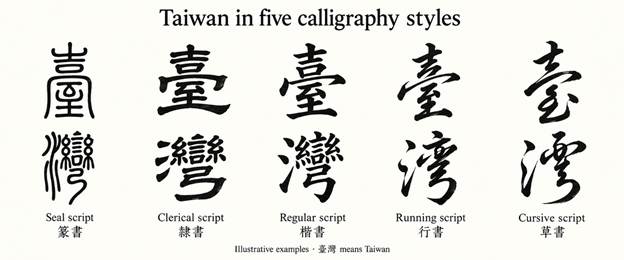
Chinese calligraphy turns writing into an art of movement. The words carry meaning, but so do the shapes, the weight of the lines, and the spaces between them. A flexible brush responds to changes in pressure, speed, and direction, leaving a visible record of the calligrapher’s hand. Even without reading Chinese, you can follow those movements across the paper.
There are five major script styles: seal script (篆書), clerical script (隸書), regular script (楷書), running script (行書), and cursive script (草書). Regular script has clearly defined strokes and is familiar to anyone who has learned to write Chinese. Running script allows strokes to flow together, while cursive abbreviates and transforms them more dramatically. Despite its name, cursive follows established conventions. Knowing ordinary printed Chinese does not automatically make it easy to read.
Start by looking at a single character. Where does the line grow thick or become delicate? Where is the ink dense, and where does the brush leave a dry, broken trail? Then look at the whole piece: the balance between characters, the spacing between columns, and the rhythm from beginning to end. Yu Yu-jen spent decades studying historical writing before developing his distinctive style. The apparent ease of his brushwork rests on a lifetime of practice.