
Ping-Pong with Mao in Taiwan: The Chairman (1969) – S6-E7

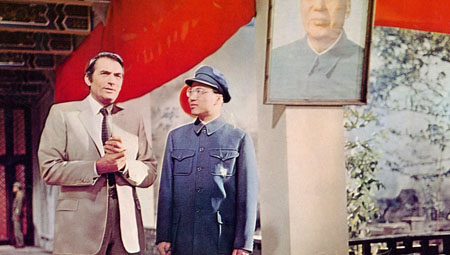
We step into the strange Cold War world of The Chairman, a forgotten 1969 spy thriller starring Hollywood great Gregory Peck. The movie, which was partly filmed in Taiwan, is about a scientist sent behind the Bamboo Curtain to steal a miracle agricultural formula. The plot is outlandish, but behind the absurdity lies an interesting snapshot of global fears in the late 1960s, from overpopulation and famine to superpower rivalry. We follow the film production here in Taiwan (a stand-in for off-limits communist China). This takes us to locations such as Taipei’s spectacular mountainside Zhinan Temple, where Peck plays ping-pong with Mao Zedong. Yes, The Chairman was a flop – deservedly so, we think – but the film certainly makes for a fun podcast episode.
Watch movie for free on YT; link below.

 Apple Podcasts
 Spotify
 RSS Feed
 RadioPublic
 PocketCasts
 Ping-Pong with Mao in Taiwan: The Chairman (1969)
Watch the movie on YouTube HERE.
We step into the strange Cold War world of The Chairman, a forgotten 1969 spy thriller starring Hollywood great Gregory Peck. The movie, which was partly filmed in Taiwan, is about a scientist sent behind the Bamboo Curtain to steal a miracle agricultural formula. The plot is outlandish, but behind the absurdity lies an interesting snapshot of global fears in the late 1960s, from overpopulation and famine to superpower rivalry. We follow the film production here in Taiwan (a stand-in for off-limits communist China). This takes us to locations such as Taipei’s spectacular mountainside Zhinan Temple, where Peck plays ping-pong with Mao Zedong. Yes, The Chairman was a flop – deservedly so, we think – but the film certainly makes for a fun podcast episode.
Below: A movie poster for The Chairman (courtesy of Wiki).

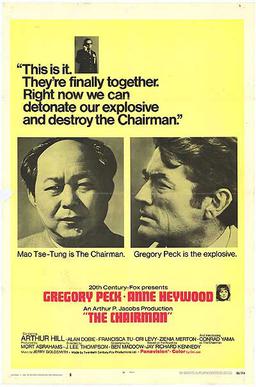
Other movies filmed in Taiwan which we mention in the episode and which we’ve previously covered are: The Sand Pebbles (1966) starring Steve McQueen; the Mel Gibson war film we referred to was Attack Force Z; we also referenced The Inn of the Sixth Happiness (originally planned to be filmed here but moved to England and Wales); and the obscure film which never saw proper release, The 11th Commandment. We also discussed Storm Over Jinmen Bay (1961 and 1963), an ROC-Japanese co-production which ran afoul of the KMT censors and needed its ending refilmed for release in Taiwan.
The movie was directed by J. Lee Thompson. And it was based on a novel by Jay Richard Kennedy.
Here’s the opening blurb from the novel, which we read out in the episode: “Somewhere in the inscrutable vastness of China the secret is hidden . . . the formula for a DNA-synthesizing enzyme that could give China dominion over the world. To find that formula, transmit, and then destroy it, the West deploys its ultimate weapon . . . one expendable man, electronically equipped as a walking, thinking bomb. This man is Jon Hathaway, who masquerades as a Canadian Maoist, Geoffrey Blair, Jr., to enter China . . .”
Parts of the movie were filmed in Taiwan, standing in for China and also Hong Kong.
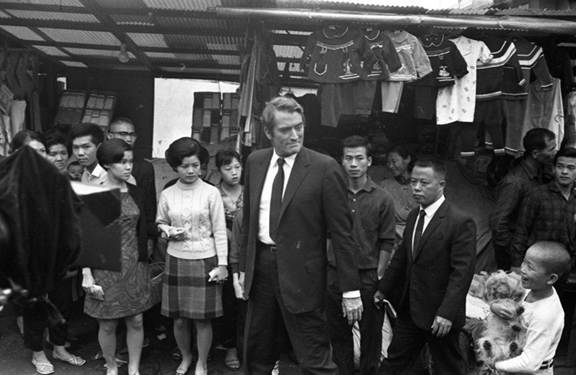
We drew on some reports in the local papers including the United Daily News. Picture below, courtesy UDN, showing Peck in Keelung’s Fude market in late 1968.
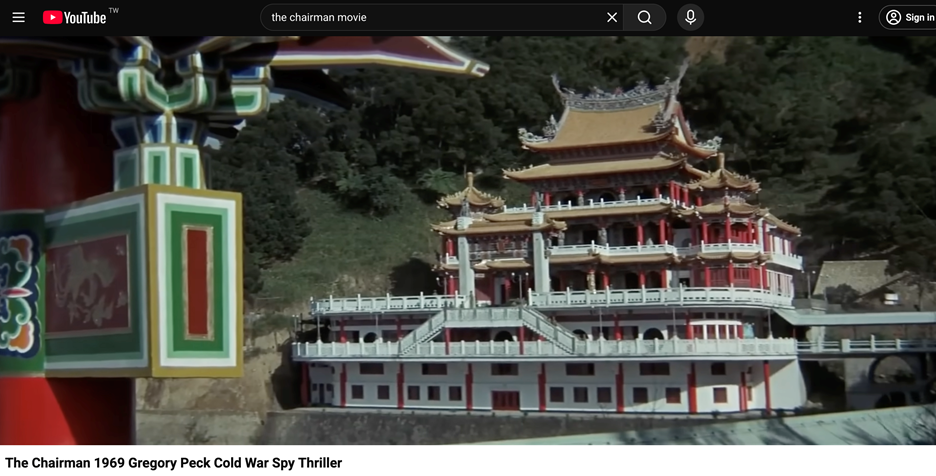
Another location was Zhinan Temple 指南宮 in the mountains to the southeast of Taipei; today it’s accessible using the cable car from Taipei Zoo to Maokong.
In the film, this is where Gregory Peck’s character meets Chairman Mao Zedong and the pair play table tennis. You can watch that scene (about 38 minutes into the film) and the rest of the movie on YouTube. This screenshot from 38:21 gives a glimpse of the main temple.
Do us a favor and rate/review the show! It really helps. Do it on Apple Podcasts or here on our website.
Write us with questions or ideas at formosafiles@gmail.com
AND THE BIGGEST REQUEST: tell others about this free, not-for-profit resource about Taiwan.
Eric Michael Smith (0:03): Welcome to Formosa Files. Today, we're up to our next and deadly cold war intrigue. We'll be sneaking behind the bamboo curtain. Yeah. We're going into red China.
Eric Michael Smith (0:14): We're We're gonna actually play ping pong with Mao Zedong in a Taiwanese Taoist temple today.
Unknown Speaker (0:18): The Taiwan history podcast, Formosa Files, is made possible through the generous sponsorship of the Frank C. Chen Foundation. Formosa Files.
Eric Michael Smith (0:31): Movies are often shot in places other than where the story is set. This can be for convenience cost or accessibility. Of course, China was off limits to Western filmmakers until let me think. Well, I guess the late nineteen eighties, The Last Emperor.
Unknown Speaker (0:47): Mhmm.
Eric Michael Smith (0:47): So films set in China, were often filmed in the West, in Hong Kong, or sometimes in Taiwan for some of that, you know, authentic free Chinese flavor.
Unknown Speaker (0:58): Yes. The Sand Pebbles starring method actor Steve McQueen. Yeah. Those method actors with, oh, I have a toothache so I can channel the pain into my performance. Oh, sorry.
Unknown Speaker (1:11): Where was I? Sand Pebbles. Okay. A major Hollywood production released in 1966. It's a good example of a movie set in China but filmed here, and we did an episode on it.
Eric Michael Smith (1:24): We also did an episode on a Mel Gibson war film shot here. It was set on an Indonesian Malay island that Taiwan stood in for.
Unknown Speaker (1:32): Yes. And most recently, we covered a film called the eleventh commandment filmed in Taiwan and set in Taiwan and China. Maybe we're not sure. No one's ever seen the film.
Eric Michael Smith (1:46): Yeah. Yeah. There's a lot of we thinks with regard to this film because we haven't been able to access it. It had a limited release in The US in 1961, but it was apparently too explosive, too anti communist for general release. I don't know.
Unknown Speaker (2:01): Do you buy that explanation?
Unknown Speaker (2:03): Hard to believe, isn't it? You've got the Cuban missile crisis in '62. And also in '62, The Manchurian Candidate, that movie comes out. It has a a plot, a rather paranoid one. It involves American POWs and the Korean War being brainwashed by the commies and programmed to assassinate the US president.
Eric Michael Smith (2:26): And, John, you're gonna be really happy or proud of me because I happen to know that in 1962, the first James Bond movie came out. Doctor. No. Oh, boy. Yes.
Eric Michael Smith (2:36): Followed by many sequels, immensely popular, and then a bunch of imitators, even parodies.
Unknown Speaker (2:42): Yeah. It was overdone, So by the end of the decade, things have changed a lot. The audience is getting wary of spy thrillers, the real ones and the parodies. So new different plot lines are needed, and the Made in Taiwan film we're going to talk about qualifies as different.
Eric Michael Smith (3:01): The Chairman, a 1969 spy thriller starring Gregory Peck, and some scenes for it were shot in Taiwan.
Unknown Speaker (3:09): Gregory Peck, the big name back in the days of Hollywood's golden age, the biggest movie star to have filmed in Taiwan, I'd argue.
Eric Michael Smith (3:17): No. Okay. Mel Gibson, we've had him, Sam Neill, Steve McQueen, Liam Neeson, Scarlett Johansson, Morgan Freeman. Yeah. You know what?
Eric Michael Smith (3:29): I'm with you on this. Gregory Peck, arguably bigger. I mean, this guy is, a legend. Right? To kill a mockingbird, he won the Academy Award for that.
Eric Michael Smith (3:37): Roman Holiday.
Unknown Speaker (3:39): My favorite of his would be the World War two adventure, the Guns of Navarone. And the same director, Jay Lee Thompson, who did the Guns of Navarone, he also did the Chairman.
Eric Michael Smith (3:51): My favorite of his was not even a it was a TV movie, The Scarlet and the Black. Saw that a lot when heard I was kid. So Gregory Peck plays this Irish priest who uses his diplomatic status and network to hide refugees from the Gestapo. Christopher Plummer plays the SS colonel, and it was just a really good film. Can you imagine?
Eric Michael Smith (4:10): Gregory Peck and Christopher Plummer?
Unknown Speaker (4:12): Excellent. Mhmm.
Eric Michael Smith (4:13): Yeah. Okay. Back to the chairman. So super huge famous star, Gregory Peck, but you will be forgiven for having never heard of the chairman.
Unknown Speaker (4:22): Why? Because it's bad. It's boring Yes. Visually dull, has a lousy plot.
Unknown Speaker (4:29): Yeah. I couldn't get through the whole thing. Parts were yeah.
Unknown Speaker (4:34): Trust me. It's not even bad in a funny way, just dull. And it was a flop at the box office. Some of the plot devices such as a bomb implanted in the hero's brain and ping pong with Mao, yeah, just struck me, struck everyone as implausible or even ridiculous.
Eric Michael Smith (4:53): The chairman in the story is, the great helmsman Mao Zedong. Yes. And the plot involves Gregory Peck playing a scientist going to China on a secret mission.
Unknown Speaker (5:05): Yes. He's asked by the US military to go to Red China and steal a special formula, but not for a nuclear weapon. No. Not a new kind of rocket fuel. No.
Unknown Speaker (5:16): Or even a cure for cancer. The formula is for an enzyme that will allow food crops to be grown in any climate.
Eric Michael Smith (5:26): Food crops to be grown. That'll teach them. Yeah. So a special formula that can end world hunger.
Unknown Speaker (5:34): In the movie, this scientific formula is what's known as a MacGuffin. It doesn't matter what it is, it's just a thing to drive the action, a thing for people to scheme for, to search for, to fight over. And maybe the most famous example of this is that small statue, the Maltese Falcon in the movie of the same name.
Eric Michael Smith (5:55): I'm trying to think of something more modern. How about the suitcase in Pulp Fiction, the briefcase?
Unknown Speaker (6:02): Too modern, never seen that.
Eric Michael Smith (6:05): Okay. We're representing our respective eras here, so, you know, it's all good. A MacGuffin. Okay. So it does, however, say something about the fears of the time.
Eric Michael Smith (6:15): People in the late sixties, they were worried about population explosions and resulting famines. I'm trying there was that famous book, right? The Population Bomb, warning about environmental collapse because of overpopulation. Of course, that means society collapses, mass starvation, all of that.
Unknown Speaker (6:33): Yes. The population bomb by Paul Ehrlich, published in 1968. The book cover had a warning in red, quote, while you are reading these words, four people will have died from starvation, most of them children, end quote.
Eric Michael Smith (6:49): Yeah. I don't know if ironic is the word, but we now live in a world where more people die from, obesity problems than from, starvation. Anyway, back to the plot. The world really needs this miraculous enzyme, which a Chinese scientist has developed, and our American scientist played by Gregory Peck is heading to China to steal it. But you know, you can't just turn up and mouse China and say, I'm here to see the Great Wall.
Unknown Speaker (7:16): China needs help in mass producing the discovery of making I forget the details, of making this enzyme thingy. Anyway, Gregory Peck's character, he has the expertise. He's going there to help them develop it.
Eric Michael Smith (7:34): Yeah. So that would be far fetched enough. But actually, the plot gets worse. He has a transmitter implanted behind his ear.
Unknown Speaker (7:42): Yes. And this will allow his controllers to monitor his conversations from a distance. And it's also a mini bomb, which can be detonated if he's captured and interrogated.
Eric Michael Smith (7:55): Being interrogated is a real possibility if one gets close to Mao Zedong.
Unknown Speaker (7:59): Right?
Eric Michael Smith (8:00): Okay. To recap the story, here's the opening blurb from the novel on which the film is based. Quote, somewhere in the inscrutable vastness of China, the secret is hidden. The formula for a DNA synthesizing enzyme that could give China dominion over the world. To find that formula, transmit, and then destroy it, the West deploys its ultimate weapon, one expendable man, a walking thinking bomb.
Eric Michael Smith (8:24): This man is John Hathaway, who masquerades as a Canadian Maoist, Jeffrey Blair junior, to enter China.
Unknown Speaker (8:31): A Canadian? Canada had warmer relations with China than did The United States.
Eric Michael Smith (8:38): Yeah. But but Canada at the point still recognize the ROC, no?
Unknown Speaker (8:43): Yes. Though that would change very soon in 1970 when Pierre Trudeau became prime minister.
Eric Michael Smith (8:50): Pierre Trudeau, father of Justin Trudeau, recently also a prime minister.
Unknown Speaker (8:56): Yes. Turning to the production of the movie, the chairman, most of the filming for it took place in The United Kingdom at the Pinewood Studios in London and at some London locations and in Wales.
Eric Michael Smith (9:11): Wales again, groan. Snowdonia, memo to movie makers, the hills of Wales do not look like Northern China.
Unknown Speaker (9:22): Yeah. They keep going back there, but no, it doesn't work. So, okay, 1968, that's when they're making the film and it's also one of the peak years of the Cultural Revolution. So the production obviously cannot go to China. They go to Hong Kong for a bit of flavor.
Unknown Speaker (9:39): In fact, some scenes in the movie were set in Hong Kong, so, you know, it's it makes sense.
Eric Michael Smith (9:45): Yes. But it didn't really work out.
Unknown Speaker (9:48): No. It didn't. Hong Kong was dealing with agitation from communist supporters, and the filmmakers were met with demonstrations and threats. Director Lee Thompson says that the crew members feared for their safety. Quote, in the end, I had to secretly photograph some of the Hong Kong scenes from cabs or private cars, end quote.
Unknown Speaker (10:08): Official filming was canceled by the Hong Kong government, and therefore production was continued in Taiwan.
Eric Michael Smith (10:15): Yeah. There are reports in the local papers recalling this. The United Daily News, the In Hebao, for example, has an article with photos from December 1. Should probably be the day after that. So, anyway, early December nineteen sixty eight.
Eric Michael Smith (10:30): Here's some lines from the article translated from the original Chinese. So, quote, the new film, The Chairman, by the American Fox Company, shot a full day of outdoor scenes yesterday at the Fuda Market in Jilong. The scenes filmed yesterday involved Gregory Peck, who plays an American scientist with a secret mission to enter bandit territory in Mainland China.
Unknown Speaker (10:52): Bandit territory.
Unknown Speaker (10:53): Oh, I love it.
Unknown Speaker (10:54): The paper is not referring to a band of brigands, but to the communists, they were called bandits, fei or commie bandits, gong fey.
Eric Michael Smith (11:05): And that continued for a really long time. Like, I don't know, maybe up until the almost to the nineties. Yeah. The article continues, quote, the chairman outdoor crew arrived in Geelong around 08:00AM in nine tour buses. In addition to lead actor Gregory Peck, dozens of male and female students from the National Taiwan Academy of Arts participated, invited to play market customers and vendors.
Unknown Speaker (11:27): Market customers and vendors. Free market enterprise. So, yeah, these Geelong scenes are standing in for Hong Kong, not the PRC, where such commerce would be a crime.
Eric Michael Smith (11:39): Continuing quote, Peck wore a dark navy suit and carried himself with calm elegance. When he stepped out of the car at Fudo Market, he frequently smiled and waved to the fans who had gathered. At one point, he was briefly surrounded and unable to move, but police protection allowed him to break free. The Geelong outdoor shoot was originally expected to be completed by yesterday morning, but due to the crowd of fans interfering with filming, it had to be extended.
Unknown Speaker (12:02): A friendly and curious Taiwanese crowd. Mhmm. I don't know food market. The name mean anything to you?
Eric Michael Smith (12:09): Yeah. I think today it's known as Renai Market, but not to be confused with the night market.
Unknown Speaker (12:16): I'm not a morning or a night market person myself.
Eric Michael Smith (12:20): Although we might have to do an episode about them because we've had a listener write in requesting we cover that subject. So, you know, I guess we shall, right?
Unknown Speaker (12:30): Yeah. Alright. Let's head to a temple and swear an oath with a chicken. Sorry,
Eric Michael Smith (12:38): listeners. It's an inside joke from a recent episode.
Unknown Speaker (12:41): Okay. Some other filming locations used in and around Taipei. Let me think there were some shots in the countryside. Our scientist has driven past some fields with red guards encouraging farmers. And apparently those art students were used as extras for red guard type scenes.
Unknown Speaker (13:00): Then we see mister Gregory Peck walking through a mountaintop monastery area up the steps to a shrine, and then we get a view of the magnificent Zhenan Temple. Have you been there?
Eric Michael Smith (13:13): Yeah. Yeah. Zhenan Temple is a wonderfully scenic setting up in the hills. Used to be rather inaccessible, but today you can get there by cable car. That cable car, Maokong, goes from Taipei Zoo to Maokong in the hills.
Eric Michael Smith (13:27): John, you have been there. Yeah?
Unknown Speaker (13:30): Many, many years ago. Yes. When it was not so accessible. I went there with my friend in her car.
Eric Michael Smith (13:39): This would be a female friend who then became your wife?
Unknown Speaker (13:42): Yeah. I've had more than one female friend in my life. But yes.
Eric Michael Smith (13:48): Okay. No. You you realize that was a very crazy, foolish thing for you to have done.
Unknown Speaker (13:56): Okay. Yes. Yes. I know what you're referring to. There's a widely held superstition related to that temple.
Eric Michael Smith (14:03): Yeah. Very simply, if unmarried couples go there together, they will break up. This comes from some legend. One of the deities worshiped their connect I forget the name. One of the eight immortals.
Unknown Speaker (14:14): Legend has it he was rejected by a woman and gets jealous of couples who visit the temple. I'm immortal, but I lost my girl.
Unknown Speaker (14:21): What a loser immortal.
Eric Michael Smith (14:24): Exactly. So evidently, your love proved greater than the jealous powers of an immortal. Impressive.
Unknown Speaker (14:32): Yes. Triumph of love. But I'm wondering why my good woman took me there. Anyway, we need to get back to Gregory Peck at the Dronan Temple. As he walks into it, his guide says, quote, you are going to visit the most important person in the history of the human race.
Eric Michael Smith (14:55): And of course, there's no question who that is. There he is, the chairman. Chairman Mao Zedong playing ping pong in a temple room. This aging Mao is, pretty useful with this paddle. He finishes the rallies playing and then he invites Gregory Peck to play a game with him.
Unknown Speaker (15:11): Lie, Ching.
Unknown Speaker (15:13): Okay. Then we get a very long scene. In some ways, a climax of the film, though it's about midway in.
Eric Michael Smith (15:21): Yep. This is one of the parts I watch. There's this annoying click clack. I guess they're trying to go for like a dramatic sound with the echo of the ball, and the ping pong sound of the game is there as the two men spar and discuss matters. It shows Mao or depicts him as rather philosophical and shrewd and implies he knows the Canadian's real identity.
Eric Michael Smith (15:42): So the entire movie is available to watch on YouTube, and I'm going to, hope that the corporation behind the film won't mind if I play at least a a tiny little snippet of it because I just gotta let people hear my my favorite line. Mao and Gregory Peck are playing ping pong, and Mao asks Gregory Peck's character, so how do you like China and what what things they could do better? And he says
Unknown Speaker (16:10): Now tell me. What thoughts would you correct? Well, I'd start with that book, the little red book. I'd buy back every copy and use the paper to wrap fish.
Eric Michael Smith (16:24): Yeah. So don't sue us, mega corporation. It is available on YouTube, the entire thing. You can watch it there if you're interested.
Unknown Speaker (16:31): Yeah. I think Gregory Peck would have been better off just saying he wanted to visit the Great Wall. But yeah, anyway, despite Mao basically knowing that he's not who he says he is, he agrees to give his foreign guest access to the Ensign and he's gonna share the discovery with the world.
Unknown Speaker (16:51): Yeah. Because that was the kind of guy Mao was, giving. Mhmm. Giving. Yeah.
Eric Michael Smith (16:56): So I guess they're engaged in a type of diplomacy involving ping pong, and I'm struggling to come up with a term that might fit this type of diplomacy. So there's ping pong and diplomacy. Struggling, struggling.
Unknown Speaker (17:13): Ping pong diplomacy?
Unknown Speaker (17:14): Oh, that's it.
Unknown Speaker (17:16): But, you know, funny, right, because it's quite prophetic. This is a taste of what would become known as, yeah, ping pong diplomacy. So this movie, despite being a stinker, is ahead of its time.
Eric Michael Smith (17:29): Mhmm. Yeah. This whole ping pong diplomacy stuff would start in '71. A chance event at the World Table Tennis Championships in Japan. An American player by the name of Glenn Cohen misses the team bus and then gets offered a ride by a Chinese player, Zhang Zedong.
Eric Michael Smith (17:45): This led to an invitation for the US table tennis team to visit China with Forrest Gump, as we later learned. They did that in April. The first group of Americans allowed into China since the communist takeover in 1949. Then in the summer, there was a secret trip there by Kissinger, and then another in October setting up the historic nineteen seventy two February visit by Richard Nixon, which would eventually lead to a decision that America is not too late to overturn.
Unknown Speaker (18:15): Turn back in your evil ways and recognize your sense. Yes. But back to the movie and let's wrap it up. Gregory Peck gets the secret of the Ensign and flees the country with the help of the Soviet army as he crosses the border in Wales. No.
Unknown Speaker (18:33): Sorry. From China to to Russia. The Soviet army help him. The Chinese military are chasing Gregory Peck. It's all rather confusing.
Eric Michael Smith (18:43): Okay. But a Soviet PRC border encounter, that's also interesting because it predicts the near future in a way. There was a brief border war or perhaps better described as a series of clashes, deadly clashes between those two neighbors' superpowers in '69.
Unknown Speaker (19:01): Right. And the Soviets asked the Americans, can we use small nukes on China? Maybe, if it came to that. And that's part of the reason that the Chinese are looking to have some diplomacy with America. Anyway, so our film comes out in 1969, same year as The Border Clashes, is something of a flop, loses money, and is largely forgotten.
Eric Michael Smith (19:28): And as with some other films shot here in Taiwan, is not shown in Taiwan.
Unknown Speaker (19:34): Right. They weren't missing much, but, yeah, a pity for those extras in the film that they couldn't see themselves up on the big screen.
Eric Michael Smith (19:42): Censorship was strict, and I think often a case of the Taiwanese government shooting itself in the foot Yeah. There's this book called Chinese National Cinema by Zhang Yingjing, and it has some interesting material on censorship in Taiwan in those years. I mean, think of the end of the sixth happiness not getting the okay because the ROC was sensitive about foot binding in 1920s China or something.
Unknown Speaker (20:04): Yeah. Yeah.
Unknown Speaker (20:05): Bad. Silly.
Unknown Speaker (20:06): Silly. So this Zhang says it was a problem for movies getting made here and also for movies being shown.
Eric Michael Smith (20:14): Oh, yeah. So, John, you're a a small government guy, a small c conservative. So check out, this quote from this book. Quote, at one point, censorship involved the joint operation of seven branches of the government. Oh.
Eric Michael Smith (20:28): Such as the Bureau of Police and Investigation, as well as the Ministries of Defense, Foreign Affairs, and Education. Representatives from these branches competed with each other in finding potential fault with films under review.
Unknown Speaker (20:40): Seven branches of government. I'm from the government, and I'm here to help you. Times seven.
Unknown Speaker (20:46): Not good.
Unknown Speaker (20:48): So basically, multiple bureaucracies competing to torpedo your project, both in the filming and the screening. Movies could not be made that would be of strategic value to the enemy. So important railroad stations and airports, possible landing sites. Oh, no. Couldn't be in the movie.
Unknown Speaker (21:08): Okay. But even if a film was anticommunist, it might run into trouble simply by showing ERC icons, Mal's portrait, the flag.
Eric Michael Smith (21:18): Right. The book gives an odd example, a movie from 1961 and 1963 called Storm Over Kinmen Bay.
Unknown Speaker (21:26): 1961 and 1963. Note the two release dates. Yeah.
Eric Michael Smith (21:31): It had to be modified. Yes. This film was co produced by a Japanese company and the China Motion Picture Company, CMPC, the government film agency, but mostly funded by the Japanese and with a Japanese director. The film tells a story of a love triangle and is, quote, set against the backdrop of the prolonged artillery shelling between the KMT controlled Jimin Islands and the PRC coast, end quote.
Unknown Speaker (21:56): The film was screened in Japan in 1961, but it was banned in Taiwan until '63, I think.
Eric Michael Smith (22:03): The censors apparently didn't like the ending. In the original ending, the Chinese slash Taiwanese woman is killed, I assume by shelling, I have not seen the movie, as she is searching for her Japanese lover. You can see the Yeah. Red flags there.
Unknown Speaker (22:18): I've not seen it either, but, yeah, it's a good assumption.
Eric Michael Smith (22:22): Yeah. Anyway, to please the censors, they change the ending. They flip it around, and they have the Japanese lover dying instead.
Unknown Speaker (22:29): Oh, boy. Anyway, Eric, let's call it a wrap on the film stories. Usually, we run out of time for shameless promotion, but we actually have a few minutes left today.
Eric Michael Smith (22:39): Alright. I'll turn this over to you for some shameless promotion. Lights, camera, action.
Unknown Speaker (22:44): Well, have you picked up your copies of China Running Dog, The Wondrous Elixir of the Two Chinese Lovers, or The Cuttlefish, or a tale of three tribes in Dutch Formosa. Those are four wonderful novels put out by Plum Rain Press, a spin off from Formosa Files. It's basically a money laundering operation.
Eric Michael Smith (23:09): Yeah. Pick up those or pick up any book. It seems that we have decided that literacy is over on the planet in favor of the wondrous, depth of emotion that can be derived from emojis.
Unknown Speaker (23:22): Yeah. It seems that reading and books are going through a difficult time. One of the few bright spots in the culture, podcasting.
Eric Michael Smith (23:31): Yes. Which is needing to move towards video, and we're working on that, very, very slowly. Anyway, thanks for sticking with Formosa Files. We appreciate you. Thanks.
Eric Michael Smith (23:42): I'm Eric Michael Smith.
Unknown Speaker (23:44): I'm John Ross. Bye.