
Sky Cop TC Brown Returns – S6-E16
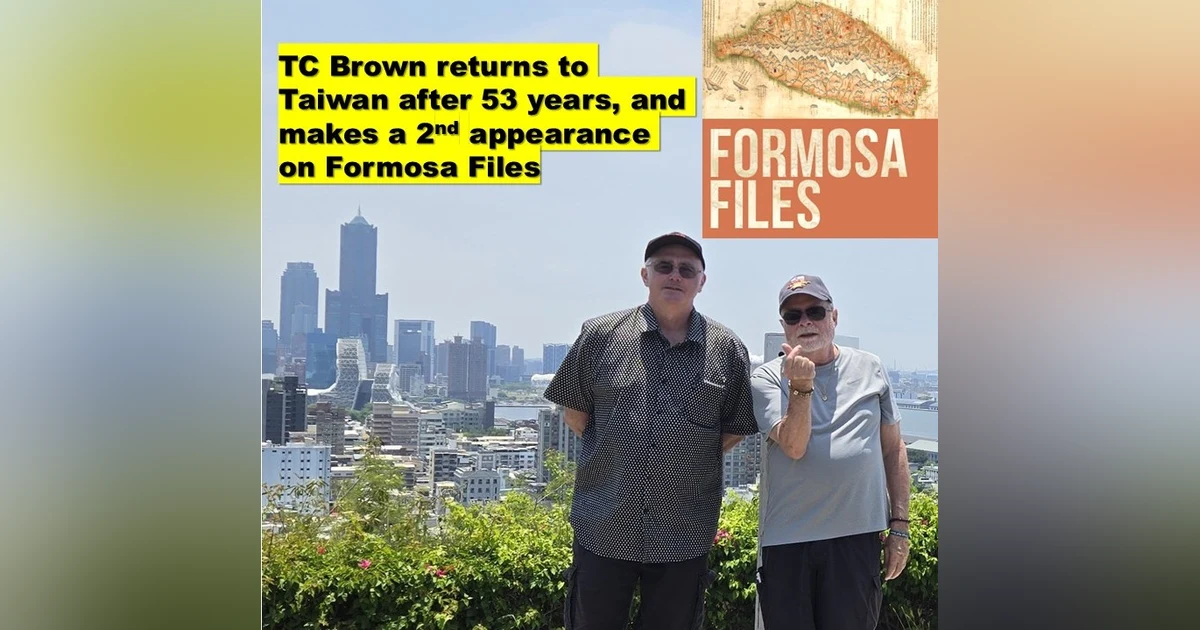
TC Brown returns to Formosa Files – and to Taiwan – after 53 years away. A former U.S. Air Force security policeman stationed at CCK Air Base in Taichung for most of 1968-73, TC reflects on his recent trip back to the island, the Taiwan he remembers from the Vietnam War era, and the Taiwan he found today. John talks with TC about his memoir Made in Taiwan and town patrol in Taichung’s “Dirty Dozen” bar district. We also visit Hualien through Wang Chen-ho’s bawdy novel Rose, Rose, I Love You, one of the few works of fiction to touch on Taiwan’s role in Vietnam War R&R.

 Apple Podcasts
 Spotify
 RSS Feed
 RadioPublic
 PocketCasts
 Show Notes
Listen to our earlier episode on CCK Air Base: “CCK: The Largest U.S. Military Base in Taiwan During the Vietnam War – S5-E27” — https://www.formosafiles.com/cck-the-largest-us-military-base-in-taiwan-during-the-vietnam-war-s5-e27/
Listen to our first interview with TC Brown: “Made in Taiwan: A Naïve American’s Chaotic Journey to Manhood in an Exotic Culture During Radical Times – Formosa Files chats with Vietnam vet and author TC Brown – S5-E28” — https://www.formosafiles.com/US-troops-in-Taiwan-Vietnam-war-S5-E28/
TC wrote a feature article for the Taipei Times about his visit back to Taiwan in late spring, 2026.
A US veteran’s return to a transformed Taiwan
https://www.taipeitimes.com/News/feat/archives/2026/06/23/2003859565
David Frazier’s review of TC Brown’s memoir: “Book review: Drugs, bars and girls: an American GI in Vietnam War-era Taiwan” — https://www.taipeitimes.com/News/feat/archives/2025/08/28/2003842798
TC Brown’s memoir on Amazon: Made in Taiwan: A Naïve American’s Chaotic Journey to Manhood in an Exotic Culture During Radical Times — https://www.amazon.com/Made-Taiwan-Americans-Chaotic-Journey/dp/1633379426
Wikipedia page for the 1984 novel Rose, Rose, I Love You https://en.wikipedia.org/wiki/Rose%2C_Rose%2C_I_Love_You_%28novel%29
Wikipedia background: Ching Chuan Kang Air Base / CCK — https://en.wikipedia.org/wiki/Ching_Chuan_Kang_Air_Base
Do us a favor and rate/review the show! It really helps. Do it on Apple Podcasts or here on our website.
Write us with questions or ideas at formosafiles@gmail.com
AND THE BIGGEST REQUEST: tell others about this free, not-for-profit resource about Taiwan.
John Ross (0:03): You're listening to Formosa Files. I'm John Ross, and today we have a repeat guest. Very happy to have TC Brown back on the program. Hi, TC.
TC Brown (0:14): Hey, John. Thank you. And it's, you know, it's great to be back here.
John Ross (0:17): You recently came back to Taiwan after, was it fifty three years away?
TC Brown (0:22): Yes. It was fifty I left in 1973 and I came back in May.
John Ross (0:27): We'll get back to your impressions of what has changed or not changed later, but we should give an introduction. You served here with the American military with the air force at the CCK Air Base from 1968 until 1973 with a what was it? A ten month stretch in Vietnam?
TC Brown (0:48): Yeah. Ten months is about right right kind of right in the middle.
John Ross (0:51): You wrote a wonderful memoir about your experiences here, made in Taiwan. What's the subtitle?
TC Brown (0:58): A naive American's chaotic journey into manhood in an alien culture during radical times.
Unknown Speaker (1:06): Okay. So tell us a little bit about the airbase in Taichung.
TC Brown (1:10): Qingchuan Kong CCK was easier to say, and that's how everybody kind of knew the base. If I remember it right, we were roughly about a twenty minute, twenty five minute bus ride from the base into Taichung with a few stops. I've seen estimates of up to 8,000 or so servicemen at the base at any one time during the Vietnam conflict, and of course The U. S. Came into Taiwan during the Korean War.
TC Brown (1:38): But at any rate, I was a security policeman and my job at one of the first few months was guarding aircraft. We we were a big support base for the Vietnam War effort. The Taiwan History Podcast Formosa Files is made possible through the generous sponsorship of the Frank C. Chen Foundation. Formosa Files.
TC Brown (2:01): We had C-one 130 cargo aircraft flying all over Asia and refueling aircraft. That was the main goal, know, that was the main charge. So I got to do that for a few months and then I got assigned to Town Patrol which was, as I mentioned, was awesome because I lived downtown, worked downtown. It was law enforcement, you know, not walking around an airplane all night long and you got extra money for it.
Unknown Speaker (2:25): I love airplanes!
TC Brown (2:26): Yeah, I do too, but you know, after you walk around for eight hours in monsoons, yeah, you're kind of like over it.
Unknown Speaker (2:34): Yeah, I can picture that, yes.
TC Brown (2:36): Yeah. So this was just way better, a way better job, and there was about 12 guys on town patrol. We worked with Chinese
John Ross (2:44): means keeping an eye on bars frequented by your fellow American military men.
TC Brown (2:51): That is correct, sir. The Dirty Dozen, that was probably the the sanctum of memories for Americans.
John Ross (2:57): The Dirty Dozen. So that's a cluster of bars in Downtown Taichung. Yeah. Actually, more than a dozen bars.
TC Brown (3:05): There was, like, one block that was almost one bar after another. So, yeah, I would guess more than a dozen for a couple of blocks, and that's where guys went. They went to hang out and kick back, throw a few down, talk to pretty girls, and buy non alcoholic drinks for them and spend wads of cash. So yeah, that that's what that was entertainment at that time.
Unknown Speaker (3:27): Okay. Well, you had a bit of entertainment on your base. You had a movie theater.
Unknown Speaker (3:32): We did. Yeah. We had
Unknown Speaker (3:33): Various clubs. Yeah. And you had a chapel?
Unknown Speaker (3:36): There was. Yes. There was.
John Ross (3:37): But on the previous episode we did, you chatting with Eric and myself, you were a bit gun shy going to that chapel on a Sunday morning. So we're gonna visit a chapel now. Okay. It's located in Hualien. It's the setting for a book called Rose, Rose, I love you.
John Ross (3:59): And you've read that book? I have. Because the Taiwan bookshelf, it comes to Vietnam War era stories, nonfiction fiction, really, really bare. There's almost nothing. One of the few things that has been done is this novel written by Wong Jian He, published in 1984, and the English version came out in 1998.
Unknown Speaker (4:22): It's set in a it doesn't give a year. It's probably about '67.
TC Brown (4:26): Premise was the these American guys from Vietnam, American GIs were coming to Hualien for a little R and R, and the some of the some of the people in the book were pretty funny but they decided to be I guess they in their mind it was patriotic to provide entertainment for the Americans and that entertainment included young ladies young ladies that would give more than just their hearts to the Americans so to speak. I'm not sure how far we can go on this podcast but you you know what they were training for and of course and the training is in a chapel which I found kind of hilarious.
John Ross (5:06): Mean Well yes the book is rather strange it's taking place in the course of a single day. And there's this opening ceremony to this crash course teaching the bar girls, about 50 of them, how to prepare. The Americans are gonna turn up a boatload of them in in about nine days or something. They have a they have about a week to get ready for these 300 Americans arriving for the first time in Hualien, a small town, small city on the East Coast. And the corrupt local councilman has got the brothel, let's say, the entertainment establishment leaders together, these four colorful bosses.
John Ross (5:46): They're in the the church at this opening ceremony. They're gonna run these classes led by a very pompous and fat English school teacher called Dong Su Wen. And teacher Dong is a windbag in both meanings of the word. Perhaps he talks a lot, and he also is prone to flatulence. He's letting rip all the time, which sort of undermines his dignity.
TC Brown (6:11): Yeah. A little. Yeah. And he actually takes pleasure in it too, as I remember from the book. Yeah.
TC Brown (6:18): It's a I mean, it's an interesting book. It was strange in in many ways, I thought, and just like some of the ironies. So Taiwan, right, was the first country there in Asia to okay gay weddings, right? Yeah, so you know in the book that at some point the guy you're just talking about gets the bright idea that not everybody is heterosexual, and so maybe we need to take care of the other fellows too. There's a few little funny scenes in there that caught my eye.
TC Brown (6:49): He had a lawyer too, Zhang Z yeah, I don't know. He was quite the character. And I love, you know, he was a lawyer that represented what was it? The city? Or I care maybe a company that a truck driving company his advice to the truck drivers like if you hit somebody you know stop and make sure they're dead and if they're not just back up over them and finish the job so I thought okay that's good That was good.
TC Brown (7:15): It was pretty funny. And my you know, I have a weird sense of humor.
John Ross (7:18): In this novel, the Americans actually don't arrive. It's just the frenzied preparations for the Americans arriving, And part of that preparation is having a health check for all the girls. They want to be clean. Did you have like public health lectures or stuff?
TC Brown (7:36): When we first got there, did. You know, they warned us about think I I even made a joke in the book about the girls are you know, they got TB or VD, so find a girl that's coughing, but it's you know, humor, I guess.
John Ross (7:51): In the book, in the preparation for the Americans arriving, they're thinking, Oh, our establishments are a little bit run down. So they think the Americans, the girls will have to be with the Americans in a hotel, and it's the only hotel in town. So it's got running water, flush toilets, it's got air conditioning and apparently the only place in town like that. Does that ring a bell?
TC Brown (8:16): Oh, absolutely. That's what I was telling people when I was there recently that I wish I could take you back in time because I think people would be shocked really. Mean because it was so different. There people didn't have cars and there was not a lot of modern stuff. So I learned while I was there after talking to some academics and some people who have researched the history because there seems to be an interest in that history.
TC Brown (8:43): Americans left in 'seventy nine, but from what these people told me, that stuff got lost in time, and I think one of the researchers told me the KMT early on like wanted to erase history, and I had I ran into one professor. He told me he's researching disco music, and he said that no one thought Taiwanese did disco music because it was all underground, but he found he said he found over 200 Taiwanese disco songs, but none of them were very good, so there's that. But heck, they did it.
John Ross (9:16): Yeah, it was kind of banned for a long time. It was an act of rebellion to head out to an underground disco place.
TC Brown (9:24): Yeah, I'm sure it was, yeah. So like I said, he found 200 songs. So yeah, you know, it's in music was so important to us back in the day, because, you know, that was like our bridge from Taiwan to we called The US the world back then, you know, that was our bridge to the world. So, it's nice that, you know, I met another professor who was also researching music. This other academic I met, she has been researching American music for ten years.
TC Brown (9:54): And she likes Taichung and CCK because there were more Americans there, and it's probably the youngest bass in all of Taiwan according to her. So for me that was exciting because I love I'm a music guy myself, so I hear that these people were doing this kind of work, You know, and they think it's important because a lot of the history got lost in time. Excellent.
John Ross (10:17): So let's get back to the bar girl training, TC. They're not ready for So the Americans this crash course for bar girls, this teacher Dong has come up with 30 phrases that they need to learn. So it's some basic stuff like, hello, how are you? And then some other things like want to do you know what? Whatever that means.
Unknown Speaker (10:43): Yeah. I don't think we have to go too far out on a limb to figure that one out.
John Ross (10:48): Another one is will you buy me a drink, John? Okay. Here's another sentence in the novel which the girls get taught. What's it like in Vietnam? This is intended to get the GIs talking about their experiences while the girls act sympathetically, know, and listen.
John Ross (11:07): Would that have worked?
TC Brown (11:08): I'm guessing most of the guys would have blown that off that they wouldn't talk about what they were seeing and doing in Vietnam. Not everybody of course, but yeah I think a lot of Vietnam vets really have never talked about it for various reasons, a lot of personal stuff.
John Ross (11:26): Okay. I'm trying my next question then. Tell me about your family. You must be homesick.
Unknown Speaker (11:35): That work for you? I I think these are bad lessons. Why would you want to bring up the guy's family so far
Unknown Speaker (11:41): from Yeah talking about your mother while you're looking at bar girls is not
Unknown Speaker (11:46): Hey mom, sorry.
John Ross (11:48): Okay anyway enough of that small talk. Jimmy, after you pay the check, how about coming to my place? Once you arrive, we have the phrase, don't be shy. Just make yourself at home. Then later on, we have the useful phrase, you are wonderful or variation, you are marvelous.
John Ross (12:10): Let's look at what the situation really was. You spent a lot of time in bars as a customer and then also as a sky cop, as a military placement. The girls picked up English on the job. It must have been pretty idiosyncratic, shall we say?
TC Brown (12:25): Yeah. I mean, I think first of all, like, no idea how many there's a lot of bars, and each bar had a lot of girls. I would say, depending on the size of the bar, there was probably always a half dozen girls in a bar. But I would think most of the ladies probably came from extremely poor backgrounds. I looked up a stat on the other day, and at that time, typical wage, monthly wage for somebody in a factory wouldn't be over a $100 a month.
TC Brown (13:00): They could go to the bar, and maybe they didn't know a lot of English, but they would soon learn because American customers came in, you know, the other girls could teach them, and, well, they had a chance to make money where they might not have the same opportunity. So and some would be shy, some would be out front in ways that would surprise you sometimes. But, I mean, it was a business, really, if you look at it like that. I mean, the people that owned the bar were making money. There was always people down there, that that place was never empty.
John Ross (13:31): Did any of your comrades marry bar girls?
TC Brown (13:35): Oh, for sure. I mean, heck, I came close to it. A lot of young men there, 8,000 miles from home, and you're you're young, and this is all new. And I don't think I was the only naive kid that went there, you know, and had my eyes open to like, wow, this is, who knew? Who knew a place like this even existed, you know?
TC Brown (13:55): And I'm not just talking about the dirty dozen, I'm just talking about Taiwan in general, the whole culture and everything, you know, it was just because heck, we were just teenagers. The only thing we ever heard about was Vietnam when I was in high school, and a place we all wanted to avoid going. It was mind blowing in a lot of ways, and you know, the the women were beautiful. I mean, there's no doubt about it, and still are, I might say. And a young guy does what a young guy does.
TC Brown (14:24): So yeah, it's hard to say how many, but I know. And guys also married other young ladies that didn't work in bars. They might work, I don't know, in a laundry, or they might work at an office, or a restaurant, you know. It wasn't like all guys and bar girls, but that was certainly part of the show.
John Ross (14:44): Yes. Just a warning about that novel, Rose, Rose, I love you, which actually, you know, the title comes from a song which was popular in Shanghai in the 1930s and later also in The US. And at the end of the opening ceremony for this training, teacher Dong gets the girls to sing it. They're planning to welcome the Americans by singing this Rose Rose, I love you song. But anyway, yeah, the novel is not very good.
John Ross (15:15): I don't think it works. It's too dependent on language wordplay, a mix of Taiwanese and Chinese and even Japanese. And it's just so hard to translate even if it does work in the original language. Let me think of an example. The teacher gives the girls English names and for example Stella is pronounced which means died, dead.
John Ross (15:48): Morning. Yeah. So like as in good morning. Morning is touch you, grope you. But a lot of this just doesn't come across in the English translation.
John Ross (16:01): Or the joke has to be explained so it loses its funniness. And hand on heart, I did not enjoy the novel. So you're not recommending it, are you TC?
TC Brown (16:12): No, not necessarily. I mean, you're right. I mean, there was some strange stuff. I thought it was you don't see this too often, you know, the author broke the wall between the audience and the story, kind of jumped in and said, yeah, well what do you think of this? Or this is kind of strange, which I thought, yeah, a little, a little bit was okay, but then it just kind of kept doing it.
TC Brown (16:34): But yeah, in the story, I think there's a really good story elements in there, but I just think it needs to be reworked.
John Ross (16:42): Well on a positive note, my goodness, there are opportunities for someone to write a good novel set in that era, plenty of material to work with. And, yeah, I mean, one of the reasons your memoir made in Taiwan has been so successful and received so much attention is not just because it's good, but because there's nothing else out there. There's one other book written by a pilot who served he was operating out of CCK Airbase, something Runway Visions.
TC Brown (17:15): Yeah. Right. That's it. I think that's the name of it. Runway visions.
TC Brown (17:19): Yeah.
John Ross (17:19): Not especially good. I'm grateful he wrote it. But once again, I I can't really recommend it unless you're some kind of airplane nut. Yeah. You alone.
John Ross (17:29): You wouldn't guess that would you? You'd think
TC Brown (17:33): No I appreciate that John. Yeah yeah I mean you know David Frazier from the Taipei Times who reviewed the book was when we were talking before it ran he asked me something I'd never thought about he said has anybody else written about, you know, this time period with Americans and Vietnam? And I go, I don't know. I never thought to look and he looked and I looked and, know, we've runway visions and somebody has told me there is one other book that might be from earlier time, like from the 60s, but again not with the entire focus, know, on the, on what happened and, and that's like coming back, that's what was so exciting to me to find out that there's really a lot of people that were interested to know what happened. I felt like I was stepping back in a kind of a time period thing and, we brought this guy back and, you know, he can tell us, you know, what it looked like and stuff, and which was great.
TC Brown (18:30): I mean, I loved it, and my intent is to come back next year if I can.
John Ross (18:35): Yeah. You know, because you guys are sorry to break it to you, not getting any younger. You know, the World War II generation has pretty much died out. We have one or two 100 year old guys that they bring out on occasion. But you know what?
John Ross (18:50): Vietnam is just twenty, thirty years later, and it's not going to be that long before we're running out of Vietnam vets who are able to talk about their experiences.
TC Brown (19:03): Yeah, the firsthand firsthand accounts are good. And like I said, I made some connections with some people over there that I intend to follow-up and including you guys and, you know, that's that's that's kind of why I went back anyway.
John Ross (19:18): TC, I've uncovered a government document from 1972. It's labeled as '73, but it's it's actually from '72. So this is just before you left Taiwan, but it's a US report. It's for military coming to Taiwan. It's to prepare people that talking about what Taiwan is like, the different services, accommodation, everything you need.
John Ross (19:45): I'm gonna read some things from it and then I want you to respond, see what you remember. Sure. So black marketing. Black marketing is very much in existence on Taiwan, and certain stores on the local economy are outlets for US Navy exchange and commissary items. Do not abuse your privileges.
John Ross (20:08): What are they talking about?
TC Brown (20:09): Well, you know, there was a healthy black market thing going on there because, again, the country itself is poor and the stuff we could get in the PX, which is like the, you know, department store, grocery store, whatever, and you know, was a Navy compound down in Taichung that now I saw like the edges of where it used to be and it's not a compound anymore. Anyway, so people would I think cigarettes and booze was was really big, but I think, you know, there was there were black market sales of appliances and things like that. Now, when I worked on Town Patrol, you know, our office headquarters was in the Navy compound, it was right kind of near the BX, and there was a liquor store. Remember a couple of times, one of my partners and I, you know, we did a little undercover stuff, know, which was just kind of hang out in the liquor store and see if we see the same people or they're buying a lot, you know, and then follow them, follow them out. A lot of times they'd walk right outside the compound and there'd be a guy with a taxi, you know, they just do the exchange right there, very stupid, and so then we could pop them, you know, but a lot of times, you know, maybe they just got in a taxi and there wasn't much we could do, but, you know, you weren't allowed to spend American money down there because it, you know, it's more valuable, and so it it that's what they meant.
TC Brown (21:31): Now I was surprised by the a little by the buy and sell. Certainly there probably had to be shops like that. I I maybe I was aware of them. I I'm just I've forgotten, you know, but it doesn't surprise me.
John Ross (21:43): Okay. So Taiwan was a huge center for pirated books, pirated records. And in this nineteen seventy three, seventy two guide, it says pirated editions of copyrighted books and records can't be taken out of the country. Was this actually enforced?
TC Brown (22:04): Not that I'm aware of, because a benefit of being there was when you went home, you know, we all bought stereo equipment, know, we bought furniture, suits, whatever. The Air Force shipped it all back for you. So you would just pack that stuff up and say, know, don't think anybody inspected it, but also a lot of times those pirated records, you know, weren't good for a lot of plays. So you know, a lot
Unknown Speaker (22:35): of
TC Brown (22:35): times what we would do, we'd get one and then we had reel to reel, that's because people ask me why did you guys have reel to reel? I said well, we could record songs out of the library or you buy the records for 25¢, you record it first, second, third time you play it, you got good music and saving money.
John Ross (22:52): Another section here, it's called buy and sell men. Buy and sell men. That doesn't sound good, does it? No.
TC Brown (23:01): No. It's raining men. Are you not gonna break out in that song, are you?
John Ross (23:05): No. It's referring to okay. I'll just read here a quote. Soon after your arrival on Taiwan and throughout your tour, you will be approached by numerous buy and sell men. Before selling them any item, ensure that you have checked to determine whether you have the required permission forms.
John Ross (23:28): Anyway, let me see what have we got here. One of the most frequent questions asked by American personnel on Taiwan is, can I sell my automobile? People selling cars? What are they talking about here?
Unknown Speaker (23:42): Well, I had a car. A lot of guys got cars. Because again
John Ross (23:48): So the car imported from The States or?
TC Brown (23:51): Well, no, from Japan, like a Datsun. I had a Datsun, you know, we had Japanese cars, but yeah, I had a lot of a number of guys had cars now and that's probably right about the permission. Yeah, I mean something that big you would need to fill out paperwork for sure, but I don't remember a ton about that, and I don't remember where I, know, I had a car and of course I sold it, I think I just sold it to another friend or something.
John Ross (24:19): Okay. We move on to food products, and it sounds pretty scary. Whenever possible, purchase food products in the commissary. Should you purchase fruits or vegetables on the local market, you should clean them thoroughly with a bleaching solution mixed with cold clear water that has been boiled. The surest way to avoid intestinal infection is to eat vegetables only after they have been thoroughly cooked.
John Ross (24:47): And then once again they're recommending that you buy all meats, seafood, even bakery products from these commissaries, these base supermarkets. Wow!
TC Brown (24:59): Yes, nothing like a little bleach to bring out the taste in a vegetable. I mean, yeah, I'm sure I saw that too. And oh yeah, we, you know, I mean, I did eat off the carts sometimes, but I was, I was pretty picky. I didn't wander out in that direction too often. But I saw some hoot.
TC Brown (25:20): I saw some amazing food that to me, I know what people love there, but it's like, really? Okay. Like the what they had, like these black eggs. And I actually saw a suit one time with it looked like tadpoles to me floating around on the top. It was offered to me like, no, thanks.
TC Brown (25:39): I'll pass trying to quit. Most nights we parked our vans on the Strip on the Dirty Dozen, you know, because that's where usually all the action was, and there was a place there called the PCS Snack Bar that they they had great fried rice and fried chicken and we actually found it, Rick Mountain and I, with the help of people from the Tai Chi Renaissance Association, we actually found some of these places that we used to hang out at, which was, it was weird, know, it was very weird to be walking around there and it's so different now, but you know, I still kind of feel, you know, I spent a lot of time down there.
John Ross (26:17): So just a final piece here. You needed a lot of immunizations. You needed a lot of jabs, which was often the case for traveling overseas in those days. And the required immunizations for personnel heading to Taiwan was for smallpox, typhoid, tetanus, diphtheria, cholera, polio, yellow fever, and influenza. Wow.
Unknown Speaker (26:43): Yeah, I think they gave it to us all in one day too. I remember some multiple shots, and you know, your arm is like, my god, but, I didn't get any of that stuff, so I'd rather have
John Ross (26:57): a shot. Overkill, it wasn't that unhealthy here. No. You know, it does show you how things have changed, so much easier to travel now isn't it, and just so wonderfully clean and healthy.
TC Brown (27:08): Absolutely, yeah. I just finished a story for the American Legion magazine that'll come out in the fall or winter, and you know, I was just saying, like, I was floored by, well, when I first went up to Taipei One Hundred One and saw Taipei, was like, holy acro. I just like seemed to stretch to the mountains, you know, and it was never like that. And then just everything I kept seeing is, you know, Taiwan is like so modern and, everything I read and see, you know, it's probably one of the freest democracies in Asia and you know, it's got a lot going for it. I mean, there's so many reasons like I'm thinking, why did I not come back sooner?
Unknown Speaker (27:46): But I got back when I got back. So hopefully I'll return.
John Ross (27:48): That's great. One of the things I love about Taiwan is that in most areas it's improving. It's getting better and better.
TC Brown (27:56): Yeah, I mean I saw that everywhere. But you know, like I said, like some things didn't change. I liked people really. I mean, you know, still some of the same I saw some of the same irritating habits as really good habits. Like people were kind, you know, they'll go out of their way to help you, they give you little gifts, you know, I mean, we could use some of that over here really.
TC Brown (28:17): But so that was kind of a connection that reawakened, you know, that I had forgotten about. And yeah, it was fun. I had a great time.
John Ross (28:27): Excellent. Okay, TC, let's paint a picture. You're a young man, what are you 20 years old, let's say, and you're in charge of what is it town patrol? You're heading out to the bars. Describe a typical evening for us.
John Ross (28:42): What are you doing and seeing?
TC Brown (28:43): Yeah sure. At that point I became a staff sergeant toward the end but yeah. So anyway we would go out on patrol, usually two of us and then two Taiwanese police, one local foreign affairs police, and one military police, and they both could speak pretty good English, and then we had it first well, early on when I first went, we had a driver. When I went back second time, we drove ourselves, but we would go down to, depending if there were no accidents or burglaries or whatever, we would tend to get down to the dirty dozen, you know, bar area, maybe we'd go out there was another bar area near CCK called Bartown in Thai Village. And so we'd go out drive out and check that, but then park the van, maybe do a walkthrough, you know, that was part of the deal.
TC Brown (29:35): We would walk through every bar putting a damper on on all the fun. Part of it was to check for passed out drunks, which, you know, we found those on occasion, including checking the bathroom for the same, passed out drunks, and the, you know, sanitary check to make sure because these were Americans being, you know, we wanted them to have soap and all that stuff. Maybe that's Toilet
Unknown Speaker (29:55): inspectors, you're not making it sound very glamorous. No,
TC Brown (29:58): no, but when you found a dude with his head half in the toilet then you knew you were doing the right thing, and we did find that by the way. So anyway, yeah, so we do that a couple times a night and sometimes you get a call out on a lot of, there were a lot of traffic accidents, know, because Americans did have cars or motorcycles, and whenever they crashed with a Taiwanese, you know, we'd have to investigate it. Yeah, and then we'd be down there till, I don't know, the bar's closed if I'm remembering, one ish or maybe two, somewhere in that time zone. But a lot of times there'd be issues, you know, there'd be trouble, so it rarely was boring because you've got alcohol involved and young people, testosterone, all of the above. You know, stupid stuff to even racial, you know, we've had racial issues.
John Ross (30:47): Yes. So listeners who want to hear some of the racial tensions, also the drug use in the military, we have two episodes, one on CCK Airbase, Eric and I did, and then we have the interview with you. Anyway, TC, time to wrap up. It was wonderful meeting you here in Taiwan and glad you had such a wonderful trip.
Unknown Speaker (31:09): Thank you.
John Ross (31:09): And just another recommendation for people to read your book, Made in Taiwan.
Unknown Speaker (31:14): Thank you. And oh, hey. Last week, I had a column in the Taipei Times. On the feature page. That was better play than when I worked in newspapers.
Unknown Speaker (31:25): I never got that creative play. That was fun.
Unknown Speaker (31:29): Excellent.