
The Fake Fishmonger – Snack 08


In the early hours of morning, Eryk and John head to a market in Taichung. Actually, they let Lin Kai-lun do that and all the other hard work. Lin is a third-generation fish seller, whose Chinese-language memoir A Guide to Fake Fishmongering tells a story of family debt, backbreaking labor, and the culture of Taiwan’s wet markets. It’s a moving story (the family brought low by gambling) and funny too (there’s some questionable medical advice). So, gather around the “urine tree” for a work-time break and fish-scented chat.

 Apple Podcasts
 Spotify
 RSS Feed
 RadioPublic
 PocketCasts
 Show Notes
In this episode, we visit Taiwan’s traditional fish-market world through the experiences of Lin Kai-lun / 林楷倫, author of A Guide to Fake Fishmongering (2022) / 《偽魚販指南》, a nonfiction memoir of fish-market life in Taiwan.. Born in Wufeng, Taichung, Lin grew up in a family that once prospered through bubble-tea shops, only to be pulled back into the fish business after his father’s gambling debts destroyed the family finances.
Cover image via What 3.0
Pic below via Eslite website:
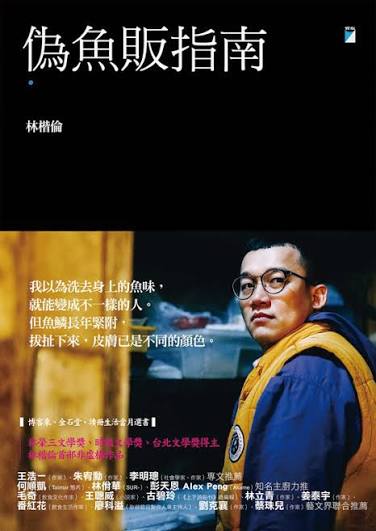
A Guide to Fake Fishmongering
Do us a favor and rate/review the show! It really helps. Do it on Apple Podcasts or here on our website.
Write us with questions or ideas at formosafiles@gmail.com
AND THE BIGGEST REQUEST: tell others about this free, not-for-profit resource about Taiwan.
Eric Michael Smith (0:00): Formosa Files. Snack. Welcome to Formosa Files Snack. I'm Eric Michael Smith.
Unknown Speaker (0:08): And I'm John Ross.
Eric Michael Smith (0:10): Okay. So in our in our story today, we're up very early this morning, well before dawn.
John Ross (0:15): What gives? Are we climbing Jade Mountain to catch the sunrise? Or better yet, are we on a secret mission to retake the mainland?
Eric Michael Smith (0:24): I've had no interest in either of those, to be honest. No. We're headed to the fish market.
John Ross (0:31): With a traditional market, the goods are out in the air, not in a fridge or even in an air conditioned building. So you've got to do things before the heat wilts the vegetables and makes the fish too
Unknown Speaker (0:45): Fishy.
Unknown Speaker (0:46): Too fishy. But how early are we talking about?
Eric Michael Smith (0:49): Auctions begin around 3AM, 03:30 maybe, but some fishmongers will still be asleep then. The early arrivals get to pick up the bargains and get access to the high quality stock before the crowd arrives. You know, that ancient Chinese proverb, the early bird catches the best fish.
Unknown Speaker (1:07): Okay. Sounds a getting up so early sounds like a human rights violation.
Unknown Speaker (1:15): A little bit.
John Ross (1:16): Yeah, okay. And with fewer people at the fish markets, the daily auctions, you can get the popular fish with less chance of entering a public bidding war. This is for people buying fish for a restaurant or a shop, not an individual looking for a piece of fish to cook for lunch.
Eric Michael Smith (1:33): Yeah. A tough trade to be in. Luckily, we're not going undercover at the fish market for our story. We are following the experiences of a fish seller, Lin Kailun. He wrote a memoir, it's a Chinese language book, and the title is okay, my translation, A Guide to Fake Fishmongering.
John Ross (1:52): Mongering, that's a difficult word for some people, selling fish. He's a fishmonger, he's a fish seller, and he's not a fake one, he's a third generation professional. A better adjective would be reluctant, but he calls himself fake because he was also a social sciences student. He's a successful novelist now, but he spent half his life trying to escape this job of fish seller.
Eric Michael Smith (2:20): Ling Kailun was born in 1986 in Taichung, Wufong to be exact, south of Taichung City. He grew up in Wufong and his family were pretty well off. His parents ran successful bubble tea shops in the city, and he remembers his father coming home with thick rolls of cash.
John Ross (2:37): His grandfather was the real fish seller. He had a fish stall located in the Wufong Market. The grandfather's wish was for young Kailun to not follow in the footsteps of the family. Study hard, don't sell fish.
Eric Michael Smith (2:53): And this is how things should have played out. But the curse of gambling, as it so often does in Taiwan, hit the family. Kailuen's father was addicted to a guessing game. I'm not sure exactly or I'm familiar, but it's some kind of illegal gambling related to price numbers.
John Ross (3:12): Yeah. I'm not familiar with it either. Seems to be an illicit underground futures ring. Yeah. With peep people betting on the commodities market, the price of pork will go down tomorrow.
John Ross (3:25): I don't know. Anything financial, right, legal or otherwise, is outside my area of expertise.
Eric Michael Smith (3:32): Sadly. Yeah. Lin recalls his father watching certain TV channels, waiting for the host to announce the prices of, like you said, pork or a certain type of fish. If the number matches his bet, he wins big, and if not, well, gulp, not so good.
John Ross (3:47): By the time Kai Lun was in the fourth grade of elementary school, the family fortunes were in the toilet. The tea shops were gone, the rolls of cash gone. The grandfather used all his hard earned savings to pay off debts. His father moved back to the family fish store. Though actually the gambling didn't stop, it was just done more discreetly.
Eric Michael Smith (4:09): I really hate not the no. The people seem to have an addiction, you know, but the the ones who keep taking the bets from people who are clearly already distressed and are not you know, it's just so evil. You should cut them off. You still can make plenty of money doing your thing, but anyway. You know, when a family's poor, sometimes they gotta turn to child labor as a free source of labor.
Eric Michael Smith (4:33): So poor Kailun spent his weekends and vacations at the fish stall. And this continued for quite a few years, including when he was in university.
John Ross (4:42): He briefly moved to Northern Taiwan to attend university, but he eventually transferred back to a university in his hometown so he could help with the family fish store. And he eventually dropped out of graduate school to become a full time fishmonger, a fish seller.
Eric Michael Smith (5:00): So now he's in a sort of a real life practical university, seafood university, lots of hands on experience. He's learning everything about fish and selling fish.
John Ross (5:11): Yeah. One of the things I found interesting in Lin's book is the different kinds of workers he describes. He says there were some employees who saved up about NT200000 They'd quit and they started their own store right across from their old boss. Seems underhand, but alas, not unusual here.
Eric Michael Smith (5:32): He describes one such case where the market became a war zone of flying ice and shouted insults. But over time, the warring parties, I guess, developed some sort of truce and sold different items, upper fin, lower fin.
Unknown Speaker (5:47): Yeah. You sell the salmon. I'll sell tilapia.
Unknown Speaker (5:51): Exactly. Mhmm.
John Ross (5:53): Actually, Lin's memoir, he mentions quite a few women working at the fish market.
Eric Michael Smith (5:57): Yes. Including a woman boss running a crew of all female workers. So a feminist fish commune. Mostly single mothers or migrant spouses. This boss lady, the La Wanyang, she didn't hire men because, quote, men aren't good things.
Eric Michael Smith (6:14): They take your money and give it to others, end quote. Men hate her. Well, she's not entirely wrong. Okay. Except in our case, it's exactly the opposite.
Unknown Speaker (6:26): Give our money to our wives. Yeah.
John Ross (6:28): Apparently, her husband was a civil servant who sat in his car scrolling on his phone while his wife hauled 20 kilogram crates of milkfish.
Eric Michael Smith (6:37): Lynn observes that behind every great woman of the market, there's usually a quote unquote soft man.
Unknown Speaker (6:44): A rather sad picture or a painting of men.
Unknown Speaker (6:47): Oh, it gets worse.
Unknown Speaker (6:49): It gets worse. We often say that or similar. I wonder if it could be a fermosophiles slogan, it gets worse or and then it got worse.
Eric Michael Smith (6:59): I like it for the hats that I'm planning on making. Yeah. The mosa vials and then it got worse. Yeah. History contains a lot of suffering though.
John Ross (7:07): Yes. It's one of the big takeaways, isn't it? How lucky we are. Anyway, where were we? Rehabilitating the reputation of men.
Eric Michael Smith (7:16): I don't know about that, but in the book, Lynn documents something called the urine tree.
John Ross (7:24): Yeah, this is a real thing apparently. In the fish market, the urine tree was a social hub. A tree nourished into a giant tree by the constant donations of male fish sellers. And this is where deals were made and gossip traded.
Eric Michael Smith (7:41): Like fellow smokers on a balcony or outside a building. But here it's a urine friends. Yeah. They're establishing relationships through impolite banter and shared urination.
John Ross (7:59): Right, standing around this stinky tree. But this job is not all fun at the fertilized tree. It's tough. The early mornings and the
Unknown Speaker (8:09): Well, you got the stench of fish.
Unknown Speaker (8:12): Yeah. You're gonna stink a fish, right?
Eric Michael Smith (8:14): The urine is just an added bonus.
Unknown Speaker (8:16): Yeah.
Eric Michael Smith (8:18): And of course, stinking like that. It can't be all that easy finding women if you work in a fish market, unless she also worked in a fish market.
John Ross (8:27): You're getting sidetracked by women.
Unknown Speaker (8:30): I always do.
John Ross (8:31): I was going to mention the health problems associated with selling fish. Lynn says that chronic waist and back pain was a fact of life for workers.
Eric Michael Smith (8:41): Yeah, injuries from carrying heavy loads. And people might be thinking, are the fish that heavy? What kind of fish are you talking about here? The weight is coming from the large amounts of ice in the containers with the fish.
John Ross (8:54): Yeah. Lynn describes an Uncle Chew, a guy with a really badly bent back and this old guy, he would wear layers of back supports, those Velcro belts, and he would tell the younger guys, don't drink ice water, it's bad for your waste.
Eric Michael Smith (9:12): That's a Taiwan classic. Ice cold drinks as poison. Anyway, there's a bit of irony here. It's carrying ice that hurts their back.
John Ross (9:21): Yeah, so obvious, right? Lin himself eventually threw his back out lifting a crate and he describes the agony of being a duck walking with a stiff, tilted pelvis while his wife and kids laughed at him. Interesting.
Eric Michael Smith (9:36): Yeah. Okay. As a cultural aside, laughing at people's misfortune, what do we do that in Taiwan? How does that work?
Unknown Speaker (9:45): I don't know. Just I would warn people, if you fall over sometimes, you might get a couple of people laughing at
Unknown Speaker (9:51): you. It could be a
John Ross (9:53): Sense of embarrassment on their They're sort of feeling embarrassed for you. They're not enjoying your misfortune.
Eric Michael Smith (9:59): A nervous reaction. Yes. Don't know what to do. You go with a laugh. Everyone laughs.
Eric Michael Smith (10:04): Anyway, what else happened? Something about a needle.
John Ross (10:08): Oh, okay. So our fish seller, our reluctant fish seller, he went to a traditional Chinese medicine doctor who stuck needles in his head acupuncture and told him his body was 45 years old when he was only in his late twenties. Can you guess what advice he gave our fishmonger?
Eric Michael Smith (10:30): Yeah. Drink less beer and lose weight.
John Ross (10:33): No. I'm talking about this guy. Okay. Yeah. That's what doctors usually tell people.
John Ross (10:39): But in this case it was, don't cross your legs, don't eat spicy food and stop drinking ice.
Eric Michael Smith (10:47): Again, with the ice taboo, that's no surprise. But wait a second, don't cross your legs. That's a new one.
John Ross (10:55): Yeah. I have no idea. Anyway, our man Lin Kailun is working at the fish market and the years are speeding by. As he turns 30, he's already married and just about to be father to his second son.
Eric Michael Smith (11:09): But his father's gambling debt had become a black hole. On the day his second kid was born, his father comes to the hospital, not with a red envelope for the baby, but to take his son, Kailan, aside and quietly ask, I'm having a little bit of trouble, son. Could you loan me 90,000 NT to pay off a loan check? 90,000 NT? That's about 3,000 US dollars.
Eric Michael Smith (11:31): Hopeless. Yeah. Pathetic. Hopeless. And it's a breaking point.
Eric Michael Smith (11:36): Lin realizes his father isn't gonna change. Working at the fish stall is just propping up an inevitable collapse.
John Ross (11:43): So he left the stall. He had no other skills. His social science degree didn't help him find a job other than as a security guard.
Eric Michael Smith (11:52): But he gets a lifeline from a chef named A Yun who told him, don't be a security guard, selfish to me.
John Ross (11:58): This started Lin's new career as a restaurant fish wholesaler. He moved from the noisy, dirty, wet market to a more refined world of supplying high end bistros and Michelin aspirant chefs.
Eric Michael Smith (12:12): Yeah. This is in Taizhong. He also became a okay. Not a real job name, but something of a a fish consultant, helping chefs choose between, you know, long tail yellow belly this or blue crested that.
Unknown Speaker (12:30): Okay. Yeah. I'm not putting that on a name card, fish consultant.
Eric Michael Smith (12:34): You know, these days, probably a very high paying job.
John Ross (12:38): He's also writing and is successful. Pretty young for that.
Eric Michael Smith (12:42): And in 2022, when he was 36, think his memoir, A Guide to Fake Fish Selling or Mongering came out.
John Ross (12:49): The moral of our story is that if you want to be a successful writer, you need to suffer a lot. I think my life has been too easy. Yours, however
Eric Michael Smith (13:00): Would indicate I need to begin writing more.
Unknown Speaker (13:03): Yes.
Eric Michael Smith (13:04): But we've run out of time. Hopefully, you've enjoyed this kind of weird snack. We're trying something different here, but definitely related to food. Time to say Zaijin. See you next time.
Unknown Speaker (13:16): Zaijin. Bye.
Unknown Speaker (13:23): Formosa Files is made possible through the generous sponsorship of the Frank C. Chen Foundation.