
Snakes of Taiwan (with Gerrut Norval) – S6-E16
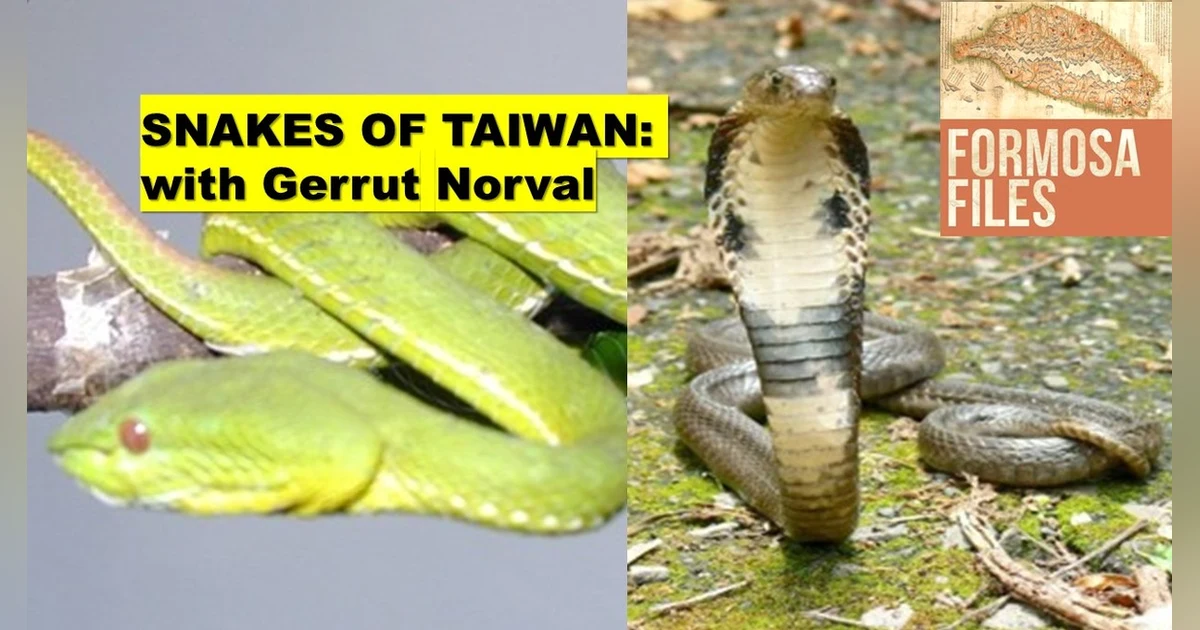
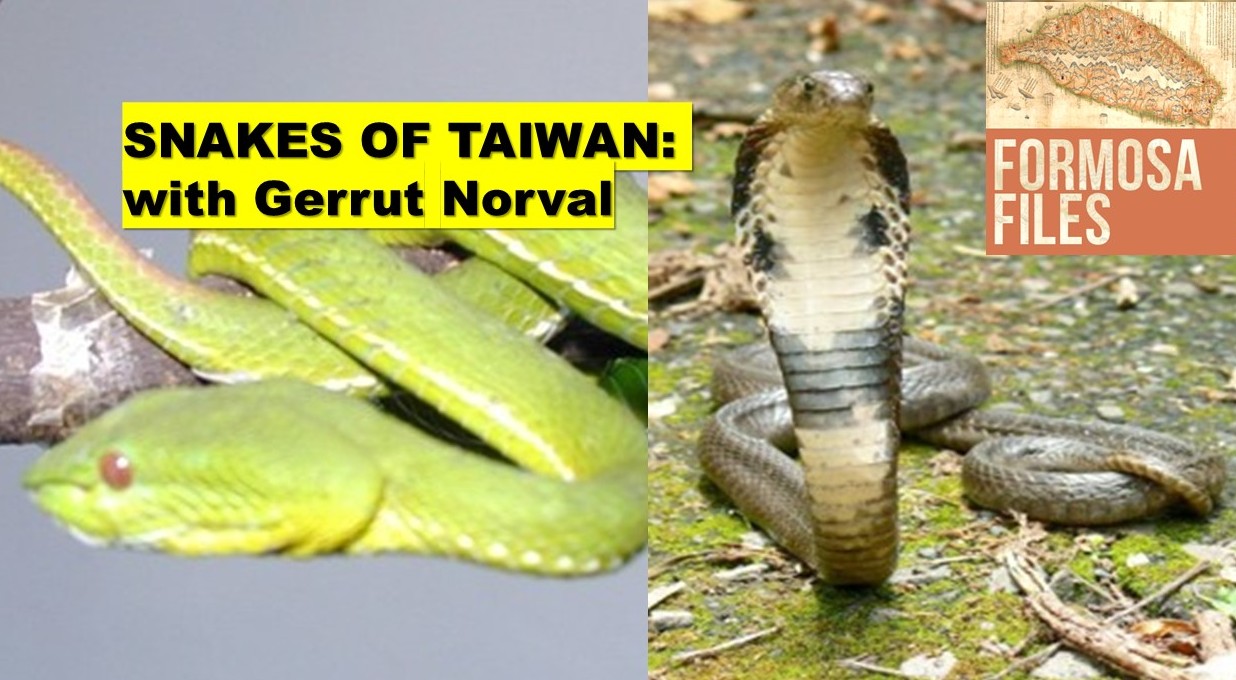
Does a “triangular head” mean danger? Did the wartime Japanese release experimental snakes on Yangmingshan? Do you really collapse after a hundred steps if a hundred-pacer bites you? Herpetologist Gerrut Norval joins John Ross to talk snakes. They focus on Taiwan’s six important venomous species: the green bamboo viper, Chinese cobra, many-banded krait, Russell’s viper, Taiwan habu, and the famous hundred-pacer. The biggest surprise for John was learning about the wild population of Burmese pythons on Kinmen. Be sure to visit the Formosa Files website for pictures and names of the snakes mentioned.

 Apple Podcasts
 Spotify
 RSS Feed
 RadioPublic
 PocketCasts
 Show Notes
This episode features guest Gerrut Norval, a researcher whose foundations are in herpetology, (the study of reptiles and amphibians). Gerrut spent nearly 20 years in Taiwan and has worked on reptiles, amphibians, invasive species, and parasites. His early Taiwan research included the brown anole, an invasive lizard species first recorded in Taiwan in Chiayi County.
Taiwan has around 65 snake species; we say “around” because the number is in flux, as classifications change. The episode focuses especially on Taiwan’s six most important venomous land snakes, while also touching on folklore, snakebite safety, Snake Alley, mercy releases, Kinmen pythons, and “fake” snakes.
Major Venomous Snakes Discussed
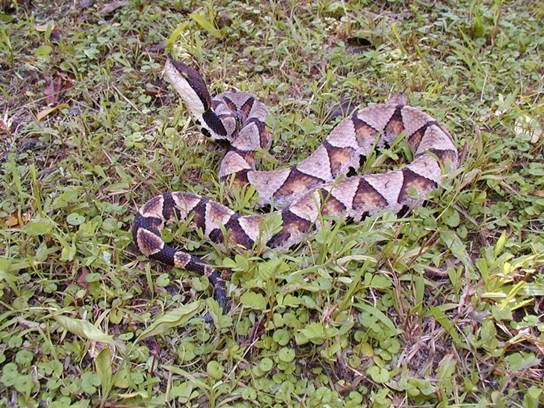
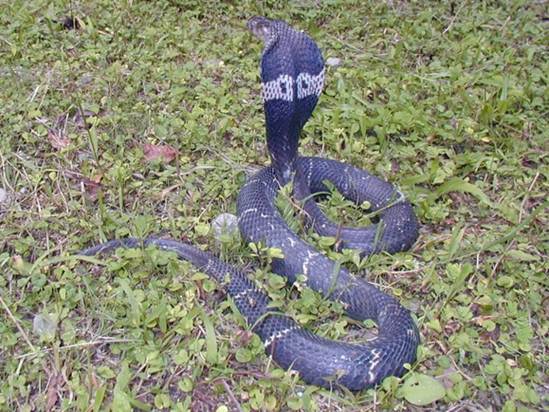
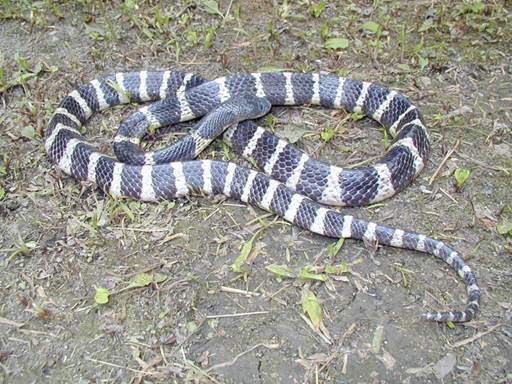
(All photos for the six snakes below are from the China Medical University Hospital website) https://www.cmuh.cmu.edu.tw/HealthEdus/Detail_EN?no=9684
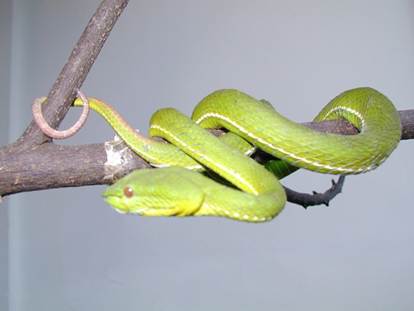
Green bamboo viper / bamboo pit viper
Probably one of Taiwan’s most commonly encountered venomous snakes. It is often found around damp areas, streams, and places where frogs are common.
Pointed-scale pit viper / Taiwan habu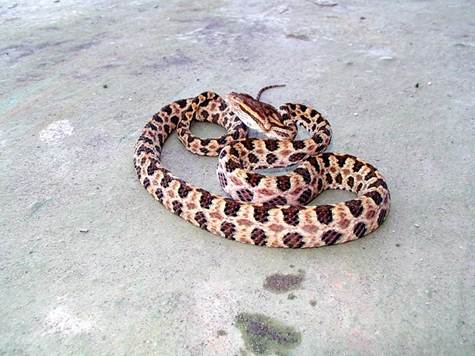
Russell’s viper
One of Gerrut’s favorite snakes. He describes it as impressive and underappreciated, with a very distinctive loud hiss.
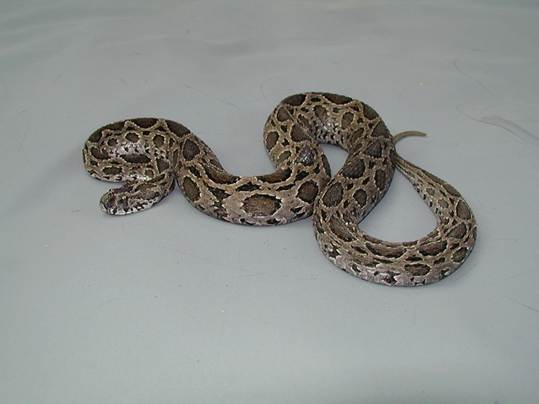
Hundred-pacer
One of Taiwan’s most famous snakes, known for its dramatic name and its importance in Indigenous Paiwan culture of southern Taiwan. It appears in their stories, art, pottery, house decoration, and chiefly symbolism. The idea that a bitten person has only “one hundred paces” before collapsing dead is a myth.
Chinese cobra
Its hood makes it easier for most people to identify than many other venomous snakes.
Many-banded krait
A highly venomous but generally docile nocturnal snake. Its Chinese name is often translated as “umbrella snake.”
Snakebites
Snakebites are much less deadly in modern Taiwan than in the past, thanks to effective antivenom and hospitals being better prepared to manage complications, including allergic reactions. Fatalities are now very rare.
Cobras and kraits have neurotoxic venom, which can affect breathing and the nervous system. Bamboo pit vipers, pointed-scale pit vipers, and hundred-pacers have hemotoxic venom, which can cause swelling, bleeding, and tissue damage.
Wartime Snake Myths
John brings up the urban legend that Japanese researchers released highly venomous snakes on Yangmingshan at the end of World War II. Gerrut says there is no evidence for this.
Kinmen Pythons
One of the most surprising sections of the episode concerns Burmese pythons on Kinmen. There were old accounts of large snakes on Kinmen, and later records and DNA studies confirmed that wild Burmese pythons occur there. Researchers concluded that the Kinmen pythons are not simply escaped pets or snakes introduced from Southeast Asia; rather, they appear to be a recovered wild population closely related to nearby Chinese populations. These pythons can reach several meters in length and are sometimes found in old bunkers, tunnels, and other man-made underground structures, which provide shelter similar to natural burrows or caves.
The main source for this is an academic paper from 2013. “Return of the pythons: First formal records, with a special note on recovery of the Burmese python in the demilitarized Kinmen Islands.” Zoological Studies 52, no. 1, article 8, 2013.
https://link.springer.com/article/10.1186/1810-522X-52-8
A more accessible read on the Kinmen pythons is this 2015 Taipei Times article:
Do giant snakes still live on Kinmen?
https://www.taipeitimes.com/News/lang/archives/2015/10/03/2003629118
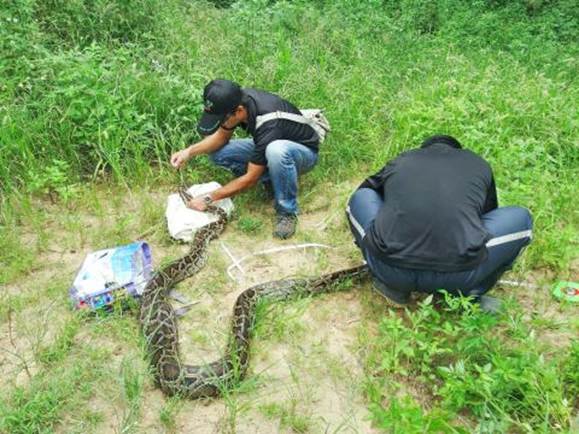
Photo: CNA (Central News Agency 中央社)
“Fake” Snakes and Mimicry
The episode ends with snakes that resemble more dangerous species. The mountain wolf snake, for example, is non-venomous but has banding that can make it look like a young many-banded krait to the untrained eye. It may put on an aggressive defensive display, but Gerrut says it may even intentionally miss when striking, because a real bite would reveal that it is not venomous. The mock viper is another snake that resembles a viper. It is rear-fanged and mildly venomous, but it is not considered dangerous to humans. This leads to a final warning: the school rule that venomous snakes have triangular heads is only a rough guideline. Some dangerous snakes do not have triangular heads, and some less dangerous snakes do.
Do us a favor and rate/review the show! It really helps. Do it on Apple Podcasts or here on our website.
Write us with questions or ideas at formosafiles@gmail.com
AND THE BIGGEST REQUEST: tell others about this free, not-for-profit resource about Taiwan.
John Ross (0:04): Welcome to Formosa Files. I'm John Ross, and today we have a very special guest, Garrett Norville. Hi, Garrett. Good morning, John. Garrett is a researcher.
John Ross (0:14): What are you researching?
Garrett Norville (0:15): At the moment, I'm actually working on reptiles and their parasites, but my research foundations were in herpetology, which is basically reptiles and amphibians and their biology.
John Ross (0:26): And you spent nearly twenty years in Taiwan and you did a lot of research and your master's thesis was on an invasive lizard species called the brown anole.
Garrett Norville (0:36): That's correct. We actually discovered lizard in Jai, so most of what is known about this animal is the research that some collaborators and I worked on.
John Ross (0:46): Yes. Some listeners might have heard of the bounty that was offered to harvest, to collect these animals. Is it fair to say it's been a complete failure?
Garrett Norville (0:56): Oh, absolutely. The numbers do not decrease, and the lizards are actually expanding their range.
Unknown Speaker (1:01): The Taiwan History Podcast, Formosa Files, is made possible through the generous sponsorship of the Frank C. Chen Foundation. Formosa Files. Invasive species is a whole another topic, but today we're gonna be talking about the snakes of Taiwan.
Garrett Norville (1:19): Yes. Very interesting creatures and very often misunderstood.
John Ross (1:23): How many species are there?
Garrett Norville (1:25): Currently there are 65 or about 65, I say about because some species their classification is actually in doubt so there may be some synonyms and there's also a possibility that there are some species that still needs to be described. So it's not an exact number, the taxonomy is not totally resolved.
John Ross (1:45): Let's concentrate on the more interesting ones, the venomous snakes, and yes it is venomous. Unless we're planning to eat the snakes, we might use the word poisonous for that but
Unknown Speaker (1:57): Correct and actually there are no poisonous snakes, all of them can be eaten if they're cooked well.
John Ross (2:02): Okay. There are probably five or six major venomous snakes in Taiwan. You've got four vipers. You've got the what is it? The bamboo, the green bamboo?
Garrett Norville (2:13): The green bamboo viper, which is most likely the most common one, usually found around water streams and things like that, wet areas. They mainly prey on frogs. Then there's the point scale pit viper or some people call it the Taiwanese haboo.
John Ross (2:28): The Taiwan Haboo, yeah, that's easier to remember, yep.
Garrett Norville (2:31): And then the Russell's Viper, which is a personal favorite of mine. And then the $101,100 peso, which is most likely the one most well known among the general public.
John Ross (2:41): So those are vipers and then we move to the cobra, the Chinese cobra.
Garrett Norville (2:47): Yeah. The the cobra is a elapid, so it's the elapidae family. So they've front fang snakes and the fangs are fixed and short and then the other elapid in Taiwan that is of safety concern is the mini banded krait.
John Ross (3:02): The mini banded krait, a very docile animal but you need to be careful because it is highly venomous.
Garrett Norville (3:07): Absolutely. Generally they will flee when approached and if you corner it and you shine a light on it for example, they're usually nocturnal so you'll encounter them at night, they will often hide their head under parts of their body, but if you step on it, you try and pick it up, you most likely will get bitten.
John Ross (3:25): And it has the undignified Chinese name. Umbrella snake? Yes.
Garrett Norville (3:31): It could be that it's it's because people encounter them after rains, so it might have something to do with the rain. But personally I don't see the umbrella.
John Ross (3:39): So the mini banded krait is an exception to the rule which children are taught at school that a triangular head is the sign of a venomous snake. These many banded crowets have a have a rounded head.
Garrett Norville (3:53): Yeah. The head is oval and actually the cobra's head is also more oval oval than triangular, but because of the hood, most people are able to identify a cobra if they see it.
John Ross (4:04): I was looking at some numbers on snake bites and fatalities back in the 1960s and 70s and it was interesting, there was about a one point five percent fatality rate for cobras, for haboos and then the mini bandit crate, about seven percent. Wow. I don't know if if that information was correct, but what would account for that?
Garrett Norville (4:28): I would say it's because it's a species that is not sensitive to human disturbance. You can find them around room rural dwellings. You will find them in rice paddies. And because it's nocturnal, I think there's a high probability that people could step on them if they don't have adequate lighting like torches or lanterns and things like that. No, that's definitely interesting and even today it's most likely the snake that causes most fatalities although not at such a high rate.
John Ross (4:57): So the cobra and the krite have neurotoxins?
Garrett Norville (5:02): That is correct. So the venom attacks the nervous system, so the snake bite victim would have difficulty breathing, but it's not necessarily a very painful bite. So I think it's also possible that people would ignore the bite until they start suffering difficulty in breathing and by that time it's actually too late to seek medical attention where if you're bitten by a viper which has a cytotoxin which attacks the tissue, bite would be very very painful so the excruciating pain would send you to the doctor almost immediately.
John Ross (5:39): And nowadays with such excellent antivenom, the fatality rate is super low.
Garrett Norville (5:46): Doctor. Oh absolutely, the antivenoms for these species are very effective and because doctors understand that some people can be allergic to the antivenom, they would be prepared. So if you stop breathing while in the hospital, they can take immediate action, where in the past I don't think many medical facilities necessarily had the right equipment to counter allergic reactions to the antivenom.
John Ross (6:11): So the fatality rate today must be something super low. I'd be surprised if it was over an average of two people a year dying from snakebite.
Garrett Norville (6:19): No, it's about that low. It's very, very rare, especially in Taiwan to hear of snakebite fatalities. And I would guess it could be people that are actually allergic to the snake venom. So the reactions would be much quicker than a normal person.
Unknown Speaker (6:35): Oh, okay.
Garrett Norville (6:36): So you you you would maybe die on the way to hospital, which is not normal. You usually have maybe an hour or two to get to a hospital.
John Ross (6:44): And the people being bitten are mostly rural folk, farmers.
Garrett Norville (6:50): Don't forget the amateur herpetologist who want to handle the animals to get a picture to put on Facebook. A lot of people, if you look at where the snake bites occur, it's often on the hands, and that is because people try and handle them.
John Ross (7:04): Right. Thankfully, with the popularity of smartphones, if someone is bitten by a snake, they don't need to go the old fashioned route of trying to beat the snake to death so they can take it into the hospital, they can just try and get a photograph of it if possible.
Garrett Norville (7:22): Correct and as long as they can provide a general description the antivenoms are a mix so they can be used for a variety of species. It's maybe only the Russell's viper which has a specific antivenom So the vipers, their antivenom as far as I know is a combination so as long as you can tell it's a Viper you're okay.
John Ross (7:45): Okay Gert I'm gonna ask you an amateur question. What's your favorite snake?
Garrett Norville (7:51): I've got a fondness of the Russell's viper. I think it's one of the venomous species in Taiwan that is least studied and, from my point of view, appreciated. I had the wonderful opportunity of handling some of them in Bingdong during a reptile survey, and it's an impressive animal. They've got a very, very loud hiss Oh. That they produce if you disturb them.
Garrett Norville (8:13): If you hear it, it's very distinctive. It's it's not something that you can mistake for something else. But I also have a favorite nonvenomous snake. It's the mountain wall snake. It's actually the snake that I've reported on the most.
Garrett Norville (8:26): Part of it was because they were the first native snake that we recorded to prey on the invasive brown anole. And with the work that I did on the mountain wolf snakes I found parasites called pentostones in them. So they were also my introduction to that type of parasite which I found rather interesting. So they provided opportunities for me to advance my understanding of ecosystems and the species in them. Okay.
Unknown Speaker (8:55): And what would be your favorite snake, John?
John Ross (8:58): I don't know, it's hard to go past the 100 pacer, it's a beautiful looking animal.
Unknown Speaker (9:02): Absolutely.
John Ross (9:03): Lovely coloring, triangular shapes and of course it features in so much of the indigenous folklore and their artwork, especially the Paiwan people of Southern Taiwan. Yeah, so the Paiwan have various legends where the 100 paisa descended to earth surrounded by clouds and basically just gave the people rain and good crops and left a huge egg. When that opened up out came a handsome young man, he announced to the people I am the son of the 100 paces snake, my name is Algis, he transforms the environment, banishes some evil spirits, it's just this sort of magical being. Then he turns into an eagle and flies away and when he's flying, some feathers drop and these feathers would become a sacred component of the Paiwan's costume, but a very hierarchical tribal group. So you have to be one of the chiefly classed to wear these eagle feathers in your costume.
John Ross (10:10): People usually assume that the Aboriginals, the indigenous people are all very egalitarian but certainly not the case with the Paiwa. The 100 peso snake also to use that motif on your pottery or your house, again commoners cannot do that. They have various legends about the 100 peso, you know, it's not written down, it's passed through certain families but basically good creatures, ancestors, guardian spirits, I don't know the details so hopefully I'm not saying anything wrong but yeah, a nice snake, it's quite calm.
Garrett Norville (10:44): Yes, it's the kind of snake again that if you approached it and it's maybe exposed, not hidden in the leaflet, it will raise its head and it will basically show you I'm here and if you let it be it will cause you no harm. It's only when you try and pick it up or if you step on it that it could actually bite you.
John Ross (11:04): 100 paces, it's a lovely name, it's a nice myth that you only get a 100 steps before you collapse but
Unknown Speaker (11:11): Unless you're allergic to it you can step a lot more than a 100 paces.
John Ross (11:15): And you don't need to really worry about how deadly these snakes are because you're very unlikely to encounter them. The Russell's viper that's Pengdong, Taidong Counties.
Garrett Norville (11:26): That's Southern Taiwan and even if you look at the general distribution, so if we say Southern Taiwan, it doesn't mean you're going to find it everywhere. They would still be habitat specific. So different snakes have different habitat preferences. And that is why you will find certain snakes in rural areas. And then there are some species that you'll never see where there are humans, they're sensitive to disturbance and you'll have to go further into less disturbed habitats to encounter them.
John Ross (11:57): I've only seen the 100 pacer once. If anyone's read my Formosan Odyssey book, chapter 20, snakes and lagers. Then I describe how I go to visit the king of snakes, a former crocodile farmer turned cobra farmer and he ran a small reptile zoo, but to quote myself, the king was no snake expert having, as he admitted to some pride, learned by the rather painful method of trial and error. Indeed he was recovering from a cobra bite so his son David showed us around the enclosures. And, yeah, he was selling, what was it, some wine?
Garrett Norville (12:37): Yes. They would place a snake that they killed into the wine and believed that it had some medicinal purposes.
John Ross (12:46): Fighting poison with poison, yeah, okay. And I forget how many bites he said he'd got but most of those would just be dry bites.
Garrett Norville (12:55): Yeah, especially adult snakes, they are able to just give a dry bite, they do not necessarily inject venom. Hatchling snakes or juvenile snakes, they're less capable of controlling the venom gland. So generally their bites would be of greater concern than an adult snake.
John Ross (13:12): Yes, and that reptile zoo had a small restaurant area where you could get your snake soup. And yes, it does taste like chicken with a little bit of a fishy taste.
Unknown Speaker (13:24): True.
John Ross (13:24): Cloves now, it's no longer running. But when people are thinking of snake soup or various snake liquors, they're probably thinking of Snake alley, Huaxi Street in Wanhua, the historical district of Taipei, a night market area and that had a notorious reputation, lots of live cobras getting skinned and chopped up into various dishes, snake blood to give you vigor. Did you go there?
Garrett Norville (13:54): I've been there, but understanding snakes I actually felt very sorry for them because they were kept in cages that would be extremely stressful. It's basically just mesh. So there's no shelter where the snake can hide. And as snakes can sense human presence in the air, the stimuli would be overwhelming. That snake would be under constant stress.
John Ross (14:17): Well thankfully, all that circus stuff is a thing of the past. Yes.
Garrett Norville (14:23): I think part of it is the venomous species are protected. You're no longer allowed to use them unless you farm them. And it's possible that the rat snakes that they were using doesn't have the draw. I also think the younger generations do not necessarily believe in the medicinal purposes of these organisms. I think the market is dying.
John Ross (14:45): Mhmm. Happy to see that go. No snake episode on Taiwan snakes would be complete without us addressing a legend. I'm calling it an urban legend related to the end of World War II, a Japanese research facility on Yangmingshan, a mountain near Taipei City. They released all these highly venomous snakes into the wild.
John Ross (15:09): But there's just one problem with that story, there's no evidence to back it up.
Garrett Norville (15:14): True, I don't think there's any indication that there are snakes in that area that are more venomous than other places. Must be pointed out the Japanese did do research.
Unknown Speaker (15:24): So you can see a reason how it could have started
Garrett Norville (15:26): Oh, absolutely. Yes. But I think the purpose of the research was to treat snake bites Yes. Because Japanese soldiers or Japanese officials were also at risk of being bitten, same as the people in Taiwan. So it's very unlikely that they would try and turn snakes into more venomous creatures for some military purposes.
Garrett Norville (15:45): It's, I think it's just a myth.
John Ross (15:46): Yes. I mean if we want to find real life examples of people releasing snakes into the wild, we could look at the mercy releases, the Buddhist inspired practice of releasing animals.
Garrett Norville (16:00): And that's a reality, that's not a myth, and it's a big problem because they will obtain these snakes from snake catchers, and they release them in places that are not necessarily suitable for the snakes. So you're introducing a snake into an area where it will slowly die. Yes. And not just in Taiwan but other parts of the world, research on snake relocation, so catching snakes in areas where they have problem and then moving them to an area where they're not a hazard to humans. The overall finding so far is those snakes rarely survive because they want to go home.
Garrett Norville (16:37): So they try to return to the area that they're familiar with, and by doing so they expose themselves to predators which they normally would be less likely to do if they were released in their own home range.
Unknown Speaker (16:48): So it's the opposite of a mercy release?
Unknown Speaker (16:51): No. It's just a slow death.
John Ross (16:52): And then in some cases you might get a foreign species establishing itself.
Garrett Norville (16:58): Absolutely. I don't think that has happened in Taiwan, but most likely because there are not that many snakes in the pet trade. There are Burmese pythons and there are reticulated pythons in the pet trade so there is a risk. I actually have a record of a tick from a Burmese python that was caught in Tainan and it was a big snake and we're not sure whether it was the snake that was released or whether it was a snake that escaped. But pit snakes do end up in the wild.
John Ross (17:29): Ticks. Quite a few of our listeners are not native English speakers, so can you explain tick?
Unknown Speaker (17:36): So a tick is an arthropod, so they are
Unknown Speaker (17:40): Oh, that helps a lot, doesn't it? They have to be
Garrett Norville (17:42): as insects and spiders and things like that. So they have eight legs, so they're not an insect and they suck the blood of other animals. So most people would be familiar with ticks on dogs.
Unknown Speaker (17:55): Okay.
Garrett Norville (17:56): And different ticks have different preferred hosts. So the ticks that bite snakes would not be the same as the ticks that bite dogs.
John Ross (18:04): Okay. We were talking before we started recording. You told me that Taiwan actually has pythons in a way.
Garrett Norville (18:11): True. During World War two, there were some accounts of pythons on Kinmen.
John Ross (18:18): Kinmen. Okay. So that's just a few kilometers off the Chinese coast, the island of Kinmen.
Garrett Norville (18:23): Correct. At the time it was speculated that they were just very large rat snakes but people became better at recording what they see so cell phones made it possible to take photographs of a snake crossing a road and things like that and they were indeed pythons and that led to a study by Doctor. Lin Zeming, if I'm not mistaken. And they found pythons on Gemini and molecular studies. So they looked at the DNA of these pythons and they compared it with the DNA of pythons from China and the surrounding areas.
Garrett Norville (18:55): And they've confirmed that they are not snakes that simply swam from China to Jimin. They are Jimin pythons.
Unknown Speaker (19:04): Wow. The picture you showed me, my goodness. That's a big beast.
Garrett Norville (19:09): Burmese pythons can grow up to about six six to eight meters depending on how long they live. It's it's a big snake.
John Ross (19:16): So listeners will be wondering, wow. So today, there are Burmese pythons living on Jimin. Correct. How is that not more widely known?
Unknown Speaker (19:25): It could be that they don't want people to know. You would have maybe people who try to collect them. Yeah. And also Jimin, since it's so close to the Mainland Chinese coast
Unknown Speaker (19:36): Yes.
Garrett Norville (19:36): And they've got military facilities there, you don't want an influx of hundreds or thousands of tourists.
John Ross (19:42): Okay, pythons like to find a burrow under the ground, a nice place to shelter. What I'm trying to lead up to is that Kinmen has a lot of man made underground places there
Garrett Norville (19:57): to shelter. The pythons are most often encountered in old bunkers and such structures. So in nature, they would find maybe a burrow dug by a big animal or a cave where they would then shelter and maybe ambush some prey. But these man made structures fulfill that.
John Ross (20:16): My goodness. I bet there have been a few scary encounters, people with some feeble flashlight and they're going through a bunker and then Even if you expect to see the snake Yes. If you know they're there and you come around a corner and there's a six meter snake lying in the corner,
Unknown Speaker (20:33): your heart will change a beat, that's for sure.
John Ross (20:36): That's remarkable. That's something people will remember unlike myself when it comes to a very famous folk story, a Chinese folk story, it's called, what is it? The Legend of the White Snake, the Lady Correct. I've looked it up three or four times, read summaries of it, but I can't remember it, which doesn't say much for the story, does it?
Garrett Norville (20:57): Unfortunately, I'm in the same boat. I'm familiar with the story and I've also read it once or twice and I do not remember
John Ross (21:04): Yes, the this foundational story. It's a big white snake which transforms into a beautiful woman. Now Chinese stories usually have that with foxes, a fox transforms into a beautiful young woman and often misleads a young scholar and saps him off his energy. In this case, the story's so old, I guess there are so many versions and there might've been a malicious snake woman in the beginning, but later I think it became more romantic. The woman and the man were happily married, but then some Buddhist monk interfered and revealed her to be a snake and imprisoned her.
John Ross (21:46): But like I say, I'm not sure.
Garrett Norville (21:49): As far as I remember, she was not a malicious character. That's correct. But like I said, the details I cannot recall.
John Ross (21:58): I think, yeah, so the takeaway is that it's an example of a snake not being malicious evil creature as in Western culture. True. If somebody wants to see a snake because I mean they're exciting, beautiful creatures to see, no snakes in New Zealand. So for me seeing snakes in Australia and also here, quite exciting.
Garrett Norville (22:19): Even people who are familiar with snakes, it's still exciting. They are remarkable creatures and if you realise that there is a potential for them to actually cause serious harm to you, you need to treat them with a lot of respect. So even though I'm very fond of snakes, treat them with the greatest of respect, it's always exciting to encounter one.
John Ross (22:39): Yes, I have no animosity towards them because they are quite creatures and when you are doing podcasts you come to appreciate that there are various birds, cats, dogs, humans with jackhammers and other creatures but yeah the snakes, even your Russell vipers hissing I don't think it's gonna be a problem
Unknown Speaker (23:01): for They're very silent unless they want to warn you, keep away.
John Ross (23:07): If someone wanted to see a snake, what's their best bet?
Garrett Norville (23:10): If possible, it would actually be good to talk to herpetologist or an amateur herpetologist and then go with someone. Because they're not the kind of creatures that you can just decide you're going to go and look at a snake today and set out tonight look for a snake. You have to know where to go. It's always better if you have somebody who could provide some guidance. You would have to go to areas outside the cities, so rural, preferably places where there's some water, you're more likely to encounter snakes around.
John Ross (23:41): A large urban park at night around a pond you're not going to see?
Garrett Norville (23:46): It depends where. There are some ponds where you might be able to see, water snakes. A few water snake species in Taiwan. And what's nice about the water snake, because they're in the water
Unknown Speaker (23:59): Mhmm.
Unknown Speaker (23:59): They tend to feel quite safe.
Unknown Speaker (24:01): Mhmm.
Garrett Norville (24:01): If So you shine a flashlight on them, they will go about their business. If you touch the water, they they're gone. Water snake on the lily pad. Okay.
John Ross (24:09): In past decades, Taiwan was known as a land of fakes, of counterfeit CDs, books, various kinds of rip offs and there are a few fake snakes, they're pretending to be well you tell the story.
Garrett Norville (24:26): Yeah, it's actually a defensive mechanism. So the mountain wolf snake, for example, has the banding is not exactly the same as a mini banded crate, but it also has patterns resembling that of a mini banded crate. So to the untrained eye, a mountain wolf snake may look like a juvenile many banded crate and unfortunately they often get bludgeoned to death for that reason.
John Ross (24:49): So this is a non venomous snake looking like a venomous snake?
Garrett Norville (24:53): Yes and their defensive display if you disturb them, very impressive. They look extremely aggressive and they'll strike out at you. And if you put your hand close to them, they'll actually intentionally miss. Because if they hit you, would give away the fact that they're nonvenomous. And then there are others that like the mock viper, which resembles a viper, but again, it's nonvenomous.
Garrett Norville (25:14): So there are venomous snakes without a triangular head, as we said earlier. And then there are nonvenomous snakes with a triangular head. So it's a good guideline, especially dealing with children, because you want them to leave snakes alone, but it's not something that is always correct.
John Ross (25:32): Yes. Anyway, Garrett, it's been wonderful talking to you.
Unknown Speaker (25:36): Thanks for the opportunity. It's always nice talking about snakes. Bye. See you. Keep well.
Unknown Speaker (25:40): Treat carefully.