
Keelung to Ishigaki Ferry: Taiwan’s Forgotten Yaeyama Stories – Snack 07
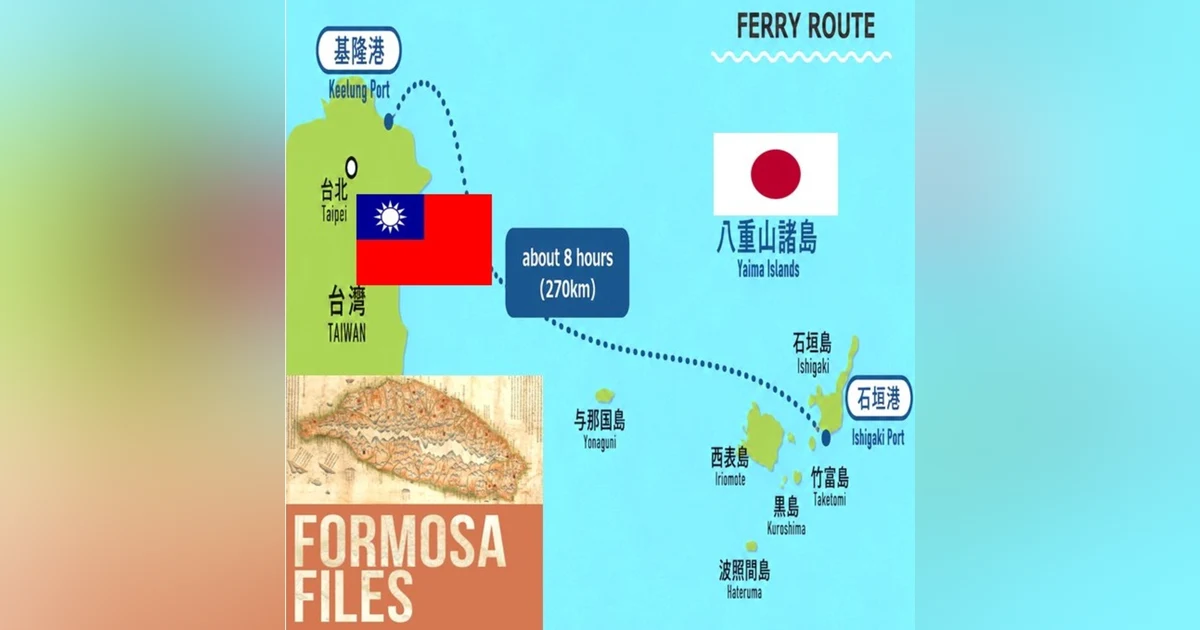
To celebrate the new Yaima Maru ferry service connecting Keelung with the Yaeyama Islands, Taiwan’s nearest neighbors, we uncover stories of Taiwanese migrants there in the Japanese colonial era. On jungle-clad Iriomote Island, some suffered brutal conditions in the coal mines. On nearby Ishigaki, Taiwanese settlers helped transform the island’s agriculture. They developed its pineapple industry and also introduced water buffalo, whose descendants can be seen today pulling tourist carts.

 Apple Podcasts
 Spotify
 RSS Feed
 RadioPublic
 PocketCasts
 Show Notes
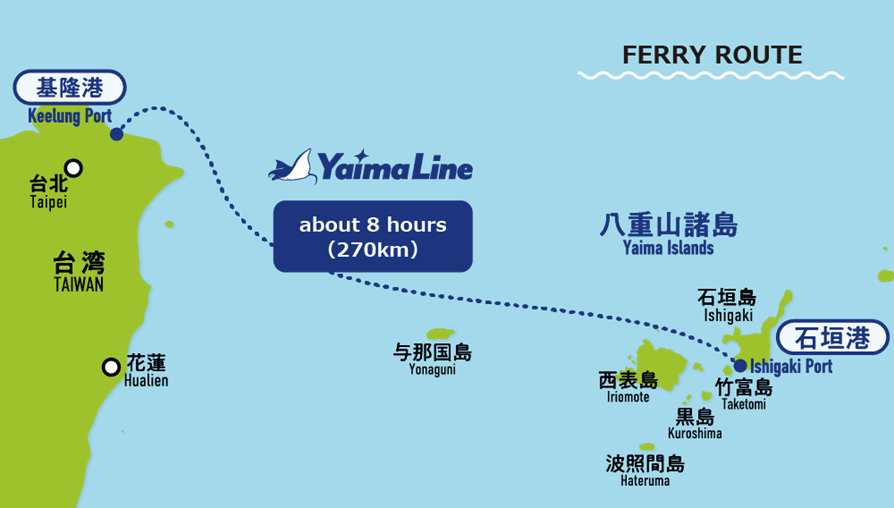
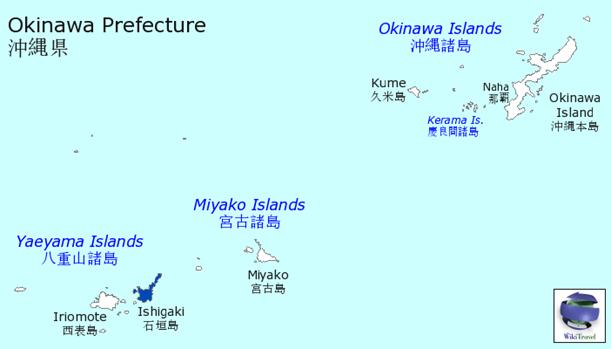
Map via Wiki Commons.
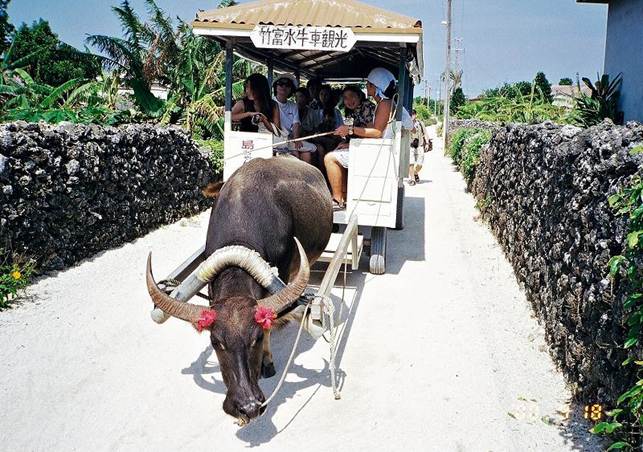
Takemori Island, which lies between Iriomote and Ishigaki islands, is known for its water buffalo. The were introduced from Taiwan in the 1930s.
Below, via Wiki Commons: A "water buffalo-car" at Taketomi-island, Okinawa Prefecture, Japan.

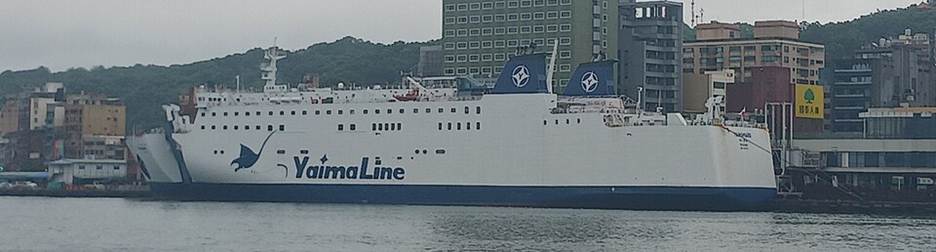
The new Keelung–Ishigaki ferry service began operating in late May 2026. The Yaima Maru takes 7-8 hours to make the overnight journey. It is operated by the Yaima Line.
Below: The Yaima Maru in 2026 via Wiki Commons

Iriomote coal mines
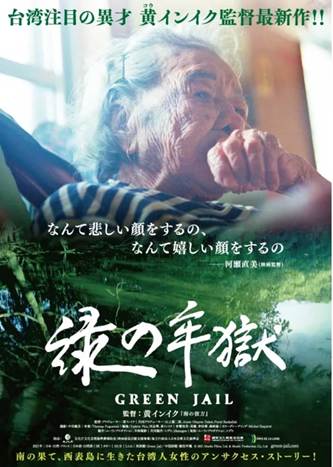
The main source for Taiwanese miners on Iriomote, was Huang Yin-Yu’s book Green Jail: Taiwanese Memories Buried in an Okinawan Mine Green Jail. The book, as well as the documentary film (poster below) of the same name, focuses on Grandma Hashima. She is described as the last Taiwanese person who knew the secrets of the notorious pre-WW2 War coal mines on Iriomote.
Photo below: Courtesy Huang’s film company website, Moolin Production.
For the story of Taiwanese farmers on Ishigaki Island, one of our sources was
Taiwan Panorama’s “Ishigaki Island’s Taiwan Village” feature article from march 1992.
Do us a favor and rate/review the show! It really helps. Do it on Apple Podcasts or here on our website.
Write us with questions or ideas at formosafiles@gmail.com
AND THE BIGGEST REQUEST: tell others about this free, not-for-profit resource about Taiwan.
Unknown Speaker (0:00): Formosophiles.
Speaker 1 (0:02): Snack. Welcome to another Formosophiles snack. Today, we're visiting some neighbors, our closest neighbors in terms of the main island of Taiwan, the Yoyama Islands of Southern Japan. They're closer than China, closer than the islands of The Philippines.
Speaker 0 (0:20): In particular, we'll be visiting the Ishigaki And Irriamote Islands, and there's a good reason for covering this story now. For the first time in almost two decades, there's once again a regular ferry sailing between the port of Geelong in Northern Taiwan and Ishigaki.
Speaker 1 (0:39): A Japanese ferry called the Yaima Maru, leaving Jilong late at night. So you sleep aboard, wake up in Japan as dawn breaks. It's 262 kilometers as the crow flies. So that's like a seven or eight hour trip.
Speaker 0 (0:53): And with different levels of accommodation, all reasonably priced. And you save on hotel accommodation.
Speaker 1 (1:00): Yeah. I'm gonna try to do that. Mhmm. Sounds fun. Oh, and the ship name, Yaima Maru.
Speaker 0 (1:07): Yaima, the local pronunciation I think for the Yaoyama Islands, and Maru is a common suffix for non military ships.
Speaker 1 (1:17): I think I've asked you before what Maru means.
Speaker 0 (1:20): That's right. It was too complicated to explain. Yeah. It's considered lucky for ships. The origins are complicated.
Speaker 0 (1:29): Basically, we aren't sure, but Maru means at a more basic level something like circle or ball.
Speaker 1 (1:37): It's the same character as the Chinese yuan as in row one meatball or yuan fish ball.
Speaker 0 (1:43): That sounds kind of undignified, but yes. They're attached to the ship name. It has the idea of protection, completeness, luck, or affection, I guess. I don't know. Historians have given several theories.
Speaker 0 (2:00): My favorite is that it relates to Japanese castles, defensive circles called maru, walls, moats. I don't know.
Speaker 1 (2:10): So the ship being viewed as a protective enclosure carrying its crew, a floating castle.
Speaker 0 (2:17): Mhmm. Yes. But to repeat, nobody knows for sure.
Speaker 1 (2:21): Alright. Moving on. Ishigaki is one of a chain of islands known as the Ryukus stretching all the way from Taiwan to Kyushu, Japan.
Speaker 0 (2:30): The Ryukus are over a thousand kilometers long and there are several island clusters. The Yaoyama Islands, then the Miyako Islands, and then in the middle, the Okinawa Islands, the main island giving its name to the whole prefecture, and then more islands all the way to Kyushu.
Speaker 1 (2:49): But let's stick to that closest group where Ishigaki is. If we sail out from Geelong in Northeast Taiwan, we first come to the island of Yonaguni. Yonaguni Island lies about a 110 kilometers from Taiwan's Northeast Coast. That's 2,000 kilometers from Tokyo. Yonaguni is small, about 10 kilometers by three kilometers, and has a population of something like 1,600 people.
Speaker 0 (3:13): Keep going East Northeast for about 75 kilometers and you reach Iriomote Island, the largest in the group and the most difficult to say. It's slightly bigger than Taipei City, about 26 kilometers long, 20 k wide, fewer than 2,500 residents though. It's covered almost entirely in jungle, mangrove swamps, mountains. It's one of the wildest islands in Japan. In fact, it's a national park.
Speaker 1 (3:45): Nearby Ioromote is the slightly smaller Ishigaki Island, home to nearly 50,000 people. It's an agricultural island and a regional transport hub and where we were talking about the place where the new ferry service takes us.
Speaker 0 (3:59): And the people there are of Japanese ancestry. They didn't arrive via nearby Taiwan or The Philippines. They came down the island chain from the north, so from Japan, and they have their own local language. It's part of the Japanese language family, but different, more of a language than just dialect.
Speaker 1 (4:19): But of course, with Japanese schooling and work and media, it's not common today.
Speaker 0 (4:25): Right. Mostly just spoken by old folks, I'd guess.
Speaker 1 (4:28): The Yoyama Islands were part of an entity called the Ryuku Kingdom from sixteen o nine to 1879. To be fair, it was kind of a fake setup, a Japanese vassal presenting as independent. This arrangement gave Japan access to Chinese goods at a time when direct trade was heavily restricted.
Speaker 0 (4:48): Yes. But things changed in the late eighteen hundreds. Japan modernized and opened up, and they formally annexed the Ryukyu Kingdom in 1879 to form Okinawa Prefecture.
Speaker 1 (5:01): Yeah. Which to this day isn't exactly completely popular with everyone there. Communists. Not only anyway, in 1895, as we all know, Japan began its rule of Formosa. In a previous episode, we discussed how people from the Ryukyu Islands came to Taiwan during the colonial period for work mostly, but also education.
Speaker 1 (5:23): And we talked about the chaotic repatriation of the islanders following Japan's surrender in 1945. That's that episode is worth a listen. But today, we're going migration. We're looking at the other way from Taiwan to the Yoyamas.
Speaker 0 (5:38): Yes. So Taiwan was part of the Japanese empire, and as such, there were opportunities to work abroad. You could go to Japan, Korea, Manchuria, and even some of the islands in Micronesia.
Speaker 1 (5:52): Yeah. Okay. Going back to your opportunities to work abroad, that has a positive ring to it, but this was more of a case of desperation, being so poor and hungry, so you believe some upbeat recruiting promotion. You know, come and make some easy money in such and such a place like Manchuria.
Speaker 0 (6:11): Yeah. These jobs might end up being little better than prison. And one such place was Iriomote Island, which was home to a few notorious coal mines run by a rather nasty mining company.
Speaker 1 (6:25): So this is that jungle covered sparsely inhabited island. Not really many local workers to be found, so they were just brought in from various parts of Japan and Taiwan.
Speaker 0 (6:35): And these workers often knew little about the work they would be doing or the conditions that they would be living in.
Speaker 1 (6:42): Quoting from a Japanese book on the minds, employment brokers would describe the job as okay. Here it is. Quote, it's warm in Irimote. There's no need of clothes. There are many women and you can eat bananas by simply extending your arms.
Unknown Speaker (7:00): You can make money and there's no better place than this. Oh, John, that sounds like paradise. Let's move.
Unknown Speaker (7:06): Women, bananas, easy money?
Unknown Speaker (7:09): No clothes.
Speaker 0 (7:10): Oh, okay. The Taiwanese workers were, I think, recruited in the mid nineteen thirties, and it would amount to several thousand over the years. This is recruiters coming to Taiwan and making promises, but what the workers found was hard work in coal mines on a jungle wilderness island. At the mines, there were also local Okinawans, Japanese, yeah, but work conditions were bad, living conditions likewise, sickness common, and workers were kind of tied to the job in this isolated place. They were getting paid in coupons, not real money, and perhaps they're getting in debt as they work.
Speaker 1 (7:55): Oh, boo. Getting paid in coupons? That's like downright evil. Remember that song 16 tons? Nope.
Unknown Speaker (8:04): They do. Okay. Yes. But I owe my soul to the company store, it ends.
Unknown Speaker (8:10): Oh, yeah.
Speaker 1 (8:11): These were were company issued tokens or papers. Workers could spend them only inside the mining settlement in the mine stores. So, basically, you're trapped in this mining economy, and I somehow doubt there was a whole bunch of women who were also willing to take tokens.
Unknown Speaker (8:26): Excuse me, boss. Where are the bananas?
Unknown Speaker (8:30): Yeah. Where do I put my clothes?
Speaker 0 (8:32): Hey. Eric, let's not be too critical. The coupons were interchangeable for banknotes and don't look too closely at the exchange rate. Oh, yeah.
Speaker 1 (8:43): I'm sure they said that as well. Right? Because of the horrible recruitment system, some workers might start of having accumulated debts due to these brokers and it's kind of not a surprise that some of them tried to escape the island. There are some dramatic stories of workers swimming across to Ishigaki.
Speaker 0 (9:03): That's quite a swim. A few hours worth, I'd guess.
Speaker 1 (9:07): Yeah. Great exercise if the sharks don't get you.
Speaker 0 (9:11): Yeah. So the plight of Taiwanese miners in the Yaoyama Islands was recently told in a documentary film, Green Jail, Taiwanese memories buried in an Okinawa mine by Taiwanese director, Huang Ying Yu.
Speaker 1 (9:26): He also wrote a book about his experiences making the documentary because this was a seven year project. The documentary focuses on an old woman, a survivor from that period, Granny Hashima. She was born in Taiwan in 1926 and brought to Irumovte by her stepfather when she was 10 years old.
Speaker 0 (9:44): Stepfather was a mine foreman kind of manager and he's to be the future father-in-law because she, this 10 year old girl, was brought into the family as a future wife for this guy's son.
Speaker 1 (9:59): Oh, so that would be one of those Simbua marriages where the future wife moves in with the family real early, totally creepy,
Unknown Speaker (10:09): live with
Speaker 1 (10:09): your live with your brother slash husband. Marry your sister. No.
Speaker 0 (10:16): Thanks. So anyway, the Hashima family returned to Taiwan for a while after the second world war, but the atmosphere was hostile. The 02/28 incident. Right? 1947 and ensuing massacres, the crackdown.
Speaker 0 (10:30): So they secretly left. They went to their old place by fishing boat.
Speaker 1 (10:36): Back to the the island. Interesting. Yeah. So then grandma Hashima would live out her days on Iro Mote, passing away in 2018, age 92. The documentary director then spent several years on historical research, one year preparing and shooting reenactments, and his film came out in 2021.
Speaker 0 (10:58): It's a rather sad story, but not all Taiwanese who crossed the sea to the Yaiyama's in those colonial days ended up slaving in coal mines.
Speaker 1 (11:08): No. At the same time as some were sweating in the coal mines, others were working as farmers and some became owners of their own land.
Speaker 0 (11:16): Ishigaki Island in the nineteen thirties, hundreds of Taiwanese agricultural settlers crossed the sea from Formosa, some arrived independently, others through organized recruitment schemes. They were drawn by promises of cheap land and opportunity, and by 1939, one settlement in Nagura District, Western Ishigaki, it was already known as Taiwan Village. That was the nickname for it. Taiwan Village. And apparently more than a 100 households and close to a thousand Taiwanese residents.
Speaker 0 (11:51): Taiwan Town.
Speaker 1 (11:52): Sounds impressive, but there's a reason the land was available. If the land had been easy to farm, local people would have already been farming it.
Speaker 0 (12:01): Right. Nobody was giving away fertile farmland out of generosity. Much of what the settlers got while cheaply rented or bought was difficult land. Malaria was common, and these were swampy areas, jungle, and wild pigs.
Speaker 1 (12:16): The Taiwanese though brought some more advanced agricultural techniques than those found on Ishiyaki. So their skills, equipment, they had improved rice strains, pineapple varieties, and perhaps most famously, water buffalo, which as we all know originally came to Taiwan via the Dutch from Indonesia or nowadays Indonesia.
Speaker 0 (12:38): Mhmm. So around '30 Taiwanese water buffalo were brought to Ishigaki during the nineteen thirties. These tough animals were well suited to the subtropical climate, and they helped with clearing and plowing the fields. The settlers planted rice, pineapples, sweet potatoes, and they raised livestock. They turned neglected land into productive farmland and a pineapple cannery opened in 1938.
Speaker 1 (13:05): Alright. As we should all know, whenever a large group of outsiders arrives and succeeds economically, starts transforming the local landscape, the local people don't usually say, oh, good for you. Yay.
Speaker 0 (13:20): Yeah. Some of that friction, some of that resistance would have been outsiders breaking customs, know, the normal way of doing things.
Speaker 1 (13:29): Yeah. So there is a fair amount of tension between Taiwanese settlers and local islanders. Language is one issue. Many Taiwanese only spoke limited Japanese. At the same time, many Yoyama Islanders spoke their local Ryukyan language rather than standard Japanese, so cultural differences and misunderstandings.
Speaker 0 (13:50): And eventually, these tensions almost exploded into violence in 1939 According to accounts, began when a local islander entered this Taiwan village and stole some lumber, some wood, which had been cut by Taiwanese settlers. He was caught and fight broke out. The man returned home and rallied support. Before long, an enormous crowd was forming. And the 1992 article I read about it put the number at nearly 2,000 people, but I'd take that with a grain of salt.
Speaker 0 (14:22): But anyway, a large mob. They're armed with clubs, machetes, and whatever weapons they could find, and they're heading towards Taiwan Village.
Speaker 1 (14:31): Thankfully, this was an almost bloody incident. One of the Taiwanese community leaders, a man called Linfa, stepped forward. He approached the crowd alone, explained the situation in Japanese, and appealed for calm. He said, people, let's let the court handle it. And
Speaker 0 (14:47): Remarkably, the angry mob listened and disaster was avoided.
Speaker 1 (14:52): Yeah, for the moment. Linfa understood that a deeper problem remained. So afterward he helped establish what was called the Taiwan Friendship Society. Its purpose was to improve relations between the two communities. Taiwanese settlers were encouraged to learn Japanese and local customs.
Speaker 1 (15:08): You gotta take off your shoes before going in the house. Separate your trash. Society members would visit neighboring villages and offer agricultural assistance, invite them to the Taiwan village for, I don't know, something Taiwanese.
Unknown Speaker (15:24): Jai Turkey rice?
Speaker 1 (15:25): I knew it. Yeah. Slowly, relationships improved.
Speaker 0 (15:29): Then of course, history intervened, the Pacific War. American forces were moving closer to Okinawa. The islands became militarized. Many Taiwanese families abandoned their farms and returned to Taiwan. Some would return after the war, but Japan and Taiwan, they're both modernizing, urbanizing.
Speaker 0 (15:50): Farming on remote islands was not that bigger drawer. It's not people's first choice.
Speaker 1 (15:55): Yeah. But the water buffalo remained along with the pineapple cultivation. They became the most lasting contributions of the Taiwanese settlers. Over the following decades, the animals spread through the Ayamas. Eventually, they became part of the tourism industry.
Speaker 1 (16:10): So when tourists are taking a ride on those famous water buffalo carts in Takeitomi Island, It's a island that doesn't have cars, a vehicle free island between Yuromote and Ishigake. They're being pulled by the descendants of animals imported from Taiwan. So I feel like we should get a cut of
Speaker 0 (16:29): that. I'll send a representative to go collect the money. Yeah. There's another water buffalo hotspot there. Buffalo carts that carry visitors across the shallow waters to Yubu Island.
Speaker 1 (16:41): Yeah. I'll try to post some pictures on the website. Yeah. You know, this isn't just for most of files pride talking. That agricultural contribution received official recognition.
Speaker 1 (16:53): In 2012, Ishigaki unveiled a monument honoring Taiwanese pioneers who helped transform the island's agriculture.
Speaker 0 (17:01): Anyway, well, our snack has grown into quite a a meal.
Speaker 1 (17:05): Yes. I will close with, I've been to Ishigaki and I enjoyed it and I recommend people go and visit our nearby islands. We were talking before we started recording about not just the Japanese ones but the ones in The Philippines as well. Our neighbors.
Speaker 0 (17:20): Yeah. We're part of a wonderful first island chain and we have lots of interesting neighbors.
Speaker 1 (17:26): Alright. Thanks for listening. I'm Eric Michael Smith.
Unknown Speaker (17:29): I'm John Ross. Bye.
Unknown Speaker (17:32): Formosa Files is made possible through the generous sponsorship of the Frank C. Chen Foundation.